Death can frame a symbolic ending, transition, release, closure, or renewal after something has completed its role. It never means or predicts physical death and does not by itself prove a breakup, job loss, illness, or any literal ending.
Choose a deck to see the card identity, number, image, relation type, and modern interpretive emphasis supported for that system.
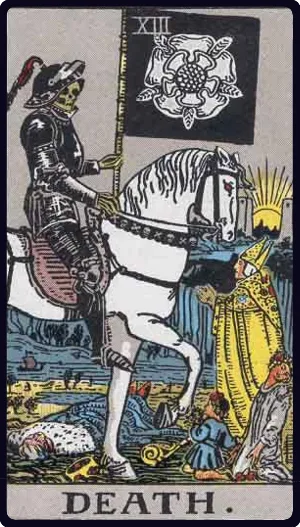
Rider–Waite–Smith
Death — Rider–Waite–Smith
Deck-native identity is shown first.
Deck-native identity
Upright emphasizes a more direct encounter with completion, transition, and release. It can support conscious closure, but it is not proof that an external ending will occur. Reversed, the primary lens is resistance to or delay in transition. Release under pressure is one material alternative when the facts support it; the reversal is not the opposite of Death and is not automatically worse.
Limit: This is a modern Venus synthesis based on the current canonical RWS-oriented reference page, not an ancient or universal doctrine. No individual visual cue is asserted in this brief; the local asset identity is known, while exact derivative provenance and rights remain unknown.
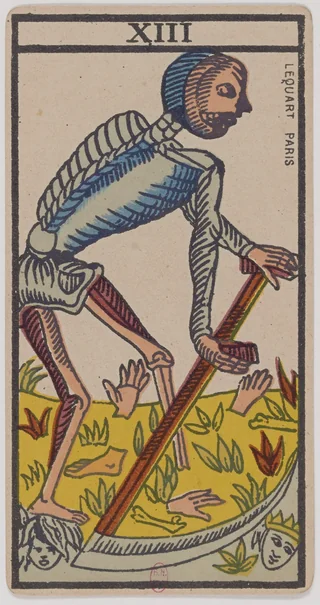
Lequart Besançon
Untitled trump XIII — Lequart Besançon
Deck-native identity is shown first.
Historical variant correspondence
Untitled trump XIII can emphasize uncompromising removal of an exhausted form so that attention and resources can be reorganized. Release may be delayed by clinging, or pursued so abruptly that necessary continuity is also cut away.
Limit: Preserve the lack of a printed title; the card does not predict physical death. This is a modern Venus synthesis informed by the observed Lequart/Besançon image; it is not presented as historical Marseille doctrine.
Sola Busca
Catone XIII — Sola Busca
Native identity: Catone.
Ordinal comparison only
Catone can emphasize mortality, consequence, and the need to close a form whose cost is already visible. Closure can be denied, dramatized, or used to erase responsibility for what must still be handled.
Limit: Brera associates Catone XIII with Death; the claim remains sourced scholarship and never predicts physical death. This is a modern Venus image-led reflection, not an original Sola Busca divinatory doctrine or a historical certainty.
Card identities, numbering, image mappings, and semantic claims have been checked against the cited sources and reviewed evidence. Each meaning is a modern reflective interpretation—not historical doctrine, a prediction, or proof of an outcome.
Locate the transition before naming an ending
This is an unpositioned reference, not an event forecast. The question, spread position, surrounding cards, and real facts must show what—if anything—the transition language applies to.
Core pattern
Something may have completed its role, creating a need for honest closure, responsible release, and space for renewal.
Position check
Advice asks what can be released responsibly; obstacle may show resistance; outcome is only a changeable transition path if the current pattern continues.
Reality check
Death cannot establish a literal event. Serious health, legal, financial, or safety concerns require facts and qualified help, not symbolic inference.
Death upright: meeting transition directly
Upright emphasizes a more direct encounter with completion, transition, and release. It can support conscious closure, but it is not proof that an external ending will occur.
Death reversed: resistance or delay
Reversed, the primary lens is resistance to or delay in transition. Release under pressure is one material alternative when the facts support it; the reversal is not the opposite of Death and is not automatically worse.
Death in love: examine change without predicting a breakup
The card may help frame a transition in expectations, patterns, or the reader's own response. It cannot prove another person's feelings or a breakup. Use observed behavior, consent, boundaries, and direct conversation to establish what is actually changing.
Death in work: review what has completed its role
Ask whether a responsibility, process, or way of working may be ready for closure or revision. Do not treat the card as proof of job loss; check actual expectations, deadlines, decisions, and options before acting.
Death in money: close or change only what the facts support
Death is not a financial forecast. It may prompt a review of a resource pattern that no longer serves its purpose, but budgets, documents, deadlines, risk, and qualified advice must guide any consequential decision.
Death as a Yes / No card
Death has no permanent yes or no value. A direction toward change is supportable only when the question concerns a real transition and the facts show that closure or release is responsible; reversed may call for more time or clarification.
Movement is more supported when
Evidence shows that a role or pattern has completed and a safe next step is available.
Pause is more supported when
The ending is assumed, the evidence is missing, or resistance is being mistaken for proof that an event must occur.
Turn the card into a responsible closure question
Name what may have completed its role, list the evidence for that view, and choose one safe step to release, close, or revise it. If health or safety fear is driving the interpretation, stop and seek real-world support.
The useful tension in Death is not whether something dramatic will happen. It is whether the current facts support honest closure and what responsibility remains before release.
Completion
What may have completed its role?
Evidence
What observable fact supports that interpretation?
Responsibility
What needs to be honored, communicated, or completed first?
Release
What one safe closure step is within the reader's control?
Apply the reference
Death needs a real question and position
Use a clearly labeled reading format only if you want to test the transition lens against a specific situation. The reference itself does not select an event.
The public meaning, physical-death limitation, and closure practice are complete here. No deeper reading can turn Death into proof of physical death, illness, breakup, job loss, or a guaranteed ending.