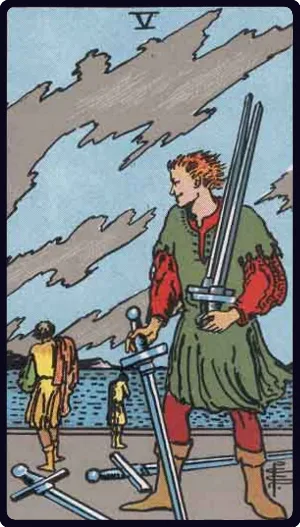
Five of Swords can foreground a conflict strategy, defensive communication, and the possible cost of trying to prevail. The useful question is not who is the villain or winner, but what tactic is observable and what it may cost dignity, trust, consent, or the larger goal.
Choose a deck to see the card identity, number, image, relation type, and modern interpretive emphasis supported for that system.
Rider–Waite–Smith
Five of Swords — Rider–Waite–Smith
Deck-native identity is shown first.
Deck-native identity
Upright, Five of Swords emphasizes consequences rather than winners. Identify the tactic, its observable impact, and whether continuing serves safety, dignity, consent, or the original purpose. If you use reversals, the primary reading is distorted: defensiveness, overthinking, or the need to prevail may warp communication and obscure the original issue. A relevant alternative is blocked, when accountability, repair, or safe disengagement is avoided and the conflict remains unresolved.
Limit: This is a modern Venus synthesis based on the current canonical RWS-oriented reference page, not an ancient or universal doctrine. No individual visual cue is asserted in this brief; the local asset identity is known, while exact derivative provenance and rights remain unknown.
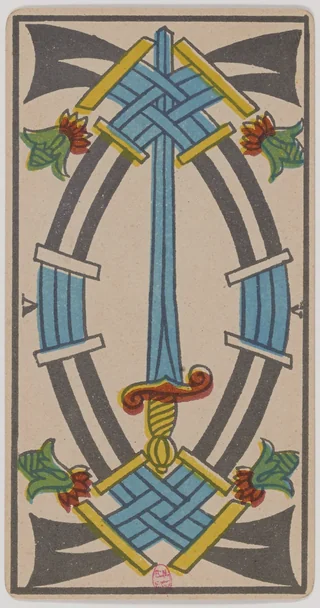
Lequart Besançon
Cinq de Épées — Lequart Besançon
Deck-native identity is shown first.
Rank-and-suit correspondence
Cinq de Épées can emphasize meeting disruption that exposes weak coordination and demands adjustment, expressed through discernment, conflict, decisions, and consequences. When excess, the same number-or-court structure can show tension that becomes conflict, fragmentation, or waste within discernment, conflict, decisions, and consequences.
Limit: This is a modern Venus number/rank-plus-suit synthesis, not a historical doctrine attributed to the Lequart maker. Read the pip or court structure directly; do not import an absent Rider–Waite–Smith narrative scene.
Sola Busca
Five of Swords — Sola Busca
Deck-native identity is shown first.
Rank-and-suit correspondence
The image can emphasize conflict that must be carried afterward, including its practical and emotional cost. Winning can become self-defeating when consequence, repair, and what is being carried are ignored.
Limit: This is a modern Venus image-led synthesis, not a historical Sola Busca divinatory doctrine. Do not import an absent Rider–Waite–Smith scene; the observed local image and rank/suit structure control the reflection.
Card identities, numbering, image mappings, and semantic claims have been checked against the cited sources and reviewed evidence. Each meaning is a modern reflective interpretation—not historical doctrine, a prediction, or proof of an outcome.
How to read Five of Swords in a real spread
This card can help examine conduct, but it cannot diagnose a person or determine whether abuse or danger is occurring. The question, orientation method, spread position, neighboring cards, evidence, consent, and safety context are not supplied.
Core layer
The card may foreground a conflict strategy, defensive communication, and the cost that trying to prevail may impose on dignity, trust, or the stated purpose.
Reading angle
Name the observable tactic and its impact before assigning motive. Then ask whether continuing serves safety and dignity or whether repair, a boundary, or safe disengagement is needed.
Reality check
The card cannot select itself, supply a spread position, prove a future event or private state, or replace direct evidence, consent, communication, emergency action, or qualified health, veterinary, legal, financial, mental-health, or safety help.
Five of Swords upright meaning
Upright, Five of Swords emphasizes consequences rather than winners. Identify the tactic, its observable impact, and whether continuing serves safety, dignity, consent, or the original purpose.
Five of Swords reversed meaning
If you use reversals, the primary reading is distorted: defensiveness, overthinking, or the need to prevail may warp communication and obscure the original issue. A relevant alternative is blocked, when accountability, repair, or safe disengagement is avoided and the conflict remains unresolved.
Five of Swords in love and feelings
In relationship questions, examine observable tactics, impact, boundaries, and repair behavior. The card cannot label someone abusive or manipulative, establish betrayal, or prove malicious intent; real concerns about coercion or danger require evidence and appropriate support.
Five of Swords in work and decisions
At work, document the conduct, its impact, and the policy or goal at stake. The card cannot prove retaliation, manipulation, revenge, or who will win; use formal channels and qualified guidance when the situation requires them.
Five of Swords in money and resources
For money, contracts, or disputes, rely on records, terms, deadlines, and qualified advice. A symbolic conflict theme cannot establish fraud, malicious intent, legal fault, or the outcome of an adversarial decision.
Five of Swords as a Yes / No card
Five of Swords leans no for an adversarial course that predictably compromises dignity, trust, consent, or safety. Whether abuse or danger is occurring is not answerable by the card and requires real-world evidence and support.
Choose another course
Do not treat symbolic permission as a reason to continue a tactic that predictably harms dignity, trust, consent, or safety.
Not answerable by Tarot
Abuse, coercion, violence, or danger assessment requires evidence, emergency action when needed, and appropriate support.
Tarot reader advice
Name the observable tactic and impact, decide on a boundary or safe disengagement, and seek appropriate support if coercion, abuse, or danger is a real concern.
Five of Swords: evaluate the tactic, not the villain
Conflict can tempt a reading into motive claims. This card is safer and more useful when the reader names conduct, measures impact, and chooses a boundary without using symbolism to diagnose another person.
Observable tactic
Record the words, conduct, or decision pattern without assigning a hidden motive.
Cost
Assess the effect on dignity, trust, consent, safety, and the original purpose.
Next boundary
Choose repair, a clear limit, or safe disengagement based on evidence and available support.
Source and limits
The local Rider-Waite-Smith-named image asset establishes no universal doctrine, provenance, authorship, edition, or licensing. The card cannot prove abuse, manipulation, betrayal, revenge, violence, or malicious intent.
Use this card in a reading
Ask the Five of Swords about conduct you can name
If you continue with a spread, frame the question around an observable tactic, its impact, and your available boundary rather than another person's hidden intent.
This public page provides the complete learning reference. An applied reading still needs a question, spread position, and context; no paid conclusion can determine abuse, danger, or malicious intent.