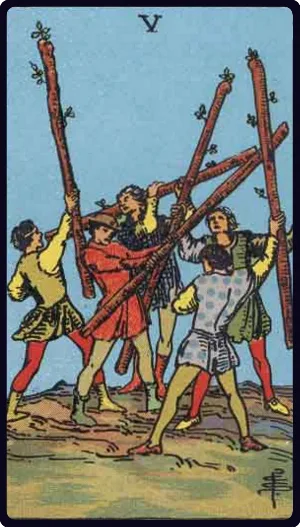
Five of Wands can foreground friction, different priorities, testing, or a coordination challenge. It does not establish literal hostility or competition; its useful task is to define the disagreement and decide which ground rule could prevent escalation.
Choose a deck to see the card identity, number, image, relation type, and modern interpretive emphasis supported for that system.
Rider–Waite–Smith
Five of Wands — Rider–Waite–Smith
Deck-native identity is shown first.
Deck-native identity
Upright, Five of Wands emphasizes observable differences and the need for structure. Name the issue, identify who is involved, and agree on rules that could keep the challenge bounded and purposeful. If you use reversals, the primary reading is blocked: friction may be avoided or left unstructured, so differences remain unresolved. A relevant alternative is excess, when heat, performance pressure, or repeated challenge escalates beyond the discussion's purpose.
Limit: This is a modern Venus synthesis based on the current canonical RWS-oriented reference page, not an ancient or universal doctrine. No individual visual cue is asserted in this brief; the local asset identity is known, while exact derivative provenance and rights remain unknown.
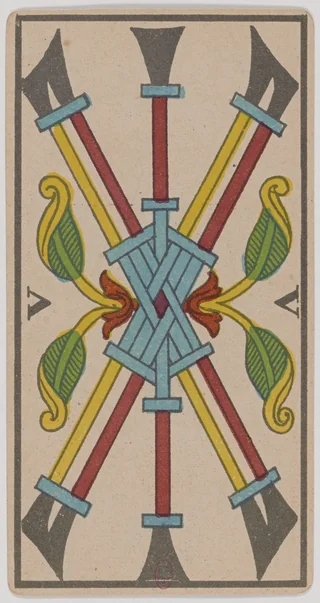
Lequart Besançon
Cinq de Bâtons — Lequart Besançon
Deck-native identity is shown first.
Rank-and-suit correspondence
Cinq de Bâtons can emphasize meeting disruption that exposes weak coordination and demands adjustment, expressed through initiative, effort, enterprise, and direction. When excess, the same number-or-court structure can show tension that becomes conflict, fragmentation, or waste within initiative, effort, enterprise, and direction.
Limit: This is a modern Venus number/rank-plus-suit synthesis, not a historical doctrine attributed to the Lequart maker. Read the pip or court structure directly; do not import an absent Rider–Waite–Smith narrative scene.
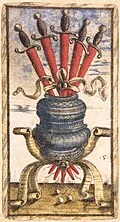
Sola Busca
Five of Batons — Sola Busca
Deck-native identity is shown first.
Rank-and-suit correspondence
The heated vessel can emphasize multiple impulses being tested, refined, or brought into productive tension. Tension can overheat into conflict, wasted effort, or activity that produces heat without direction.
Limit: This is a modern Venus image-led synthesis, not a historical Sola Busca divinatory doctrine. Do not import an absent Rider–Waite–Smith scene; the observed local image and rank/suit structure control the reflection.
Card identities, numbering, image mappings, and semantic claims have been checked against the cited sources and reviewed evidence. Each meaning is a modern reflective interpretation—not historical doctrine, a prediction, or proof of an outcome.
How to read Five of Wands in a real spread
This page offers a possible lens, not proof that a fight exists. A personal reading still needs the question, orientation method, spread position, neighboring cards, participants, consent, and real safety facts.
Core layer
The card may foreground friction, different priorities, testing, or a coordination problem without establishing rivalry, hostility, or violence.
Reading angle
Identify the actual issue, the participants, and the shared purpose. Then set a rule that makes challenge useful rather than assuming struggle will produce growth.
Reality check
The card cannot select itself, supply a spread position, prove a future event or private state, or replace direct evidence, consent, communication, emergency action, or qualified health, veterinary, legal, financial, mental-health, or safety help.
Five of Wands upright meaning
Upright, Five of Wands emphasizes observable differences and the need for structure. Name the issue, identify who is involved, and agree on rules that could keep the challenge bounded and purposeful.
Five of Wands reversed meaning
If you use reversals, the primary reading is blocked: friction may be avoided or left unstructured, so differences remain unresolved. A relevant alternative is excess, when heat, performance pressure, or repeated challenge escalates beyond the discussion's purpose.
Five of Wands in love and feelings
In relationship questions, examine observable disagreement, competing needs, and repair behavior. The card cannot prove hostility, aggression, violence, or another person's intent to fight.
Five of Wands in work and decisions
At work, distinguish a coordination problem from literal rivalry. Clarify the decision, roles, forum, and ground rules; the card does not prove workplace competition or promise that conflict will improve performance.
Five of Wands in money and resources
For money or resource disputes, use documents, budgets, roles, and qualified advice to identify the actual difference. A tense symbol cannot establish hostile intent, legal fault, or the safest financial action.
Five of Wands as a Yes / No card
The yes/no answer is unclear. It can lean yes only for a bounded challenge with consent, a shared purpose, ground rules, and safety; it leans no when escalation, coercion, or safety risk is present.
Can lean yes when
Participants consent, the purpose is shared, rules are explicit, and the challenge can remain safe.
Leans no when
Coercion, escalation, unsafe behavior, or the lack of a workable ground rule makes participation harmful.
Tarot reader advice
Define the actual point of difference, set one ground rule, and decide whether to coordinate, pause, or seek support before escalation.
Not every disagreement is a battle, and not every challenge is productive. The card becomes useful when the reader can name the difference and establish what safe participation requires.
Point of difference
State the exact issue instead of treating general tension as proof of hostility.
Shared purpose
Confirm what participants are trying to accomplish and whether they consent to the challenge.
Ground rule
Set one limit on tone, time, conduct, or escalation before continuing.
Source and limits
The Rider-Waite-Smith-named image asset establishes no universal doctrine, provenance, authorship, edition, or licensing. The card cannot prove rivalry, workplace competition, hostility, violence, or automatic growth through struggle.
Use this card in a reading
Ask the Five of Wands about a defined disagreement
If you apply this card in a spread, name the issue, shared purpose, consent, and safety limits before asking what coordination might help.
This public reference fully explains the card's learning value. A reading still needs a question, spread position, and context, and it cannot replace real support when coercion or safety risk is present.