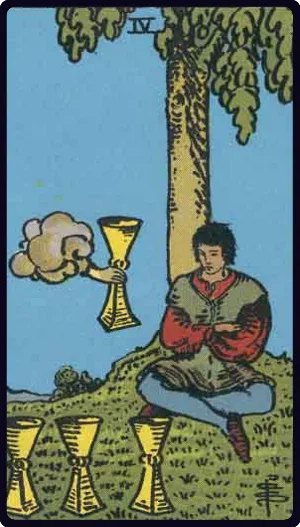
Four of Cups can bring attention inward when a person is not ready to respond automatically. It may frame disengagement, dissatisfaction, or reassessment, but it cannot diagnose the pause or tell you that an offer or rejection exists.
Choose a deck to see the card identity, number, image, relation type, and modern interpretive emphasis supported for that system.
Rider–Waite–Smith
Four of Cups — Rider–Waite–Smith
Deck-native identity is shown first.
Deck-native identity
Upright, Four of Cups emphasizes a pause in engagement. Name what feels unconvincing, confirm the option that is actually available, and decide whether more information is needed before answering. If you use reversals, the primary reading is internalized: attention may turn so far inward that preferences and available choices become harder to state. A relevant alternative is distortion, when an idealized absent option or avoided feeling obscures what is present.
Limit: This is a modern Venus synthesis based on the current canonical RWS-oriented reference page, not an ancient or universal doctrine. No individual visual cue is asserted in this brief; the local asset identity is known, while exact derivative provenance and rights remain unknown.
Lequart Besançon
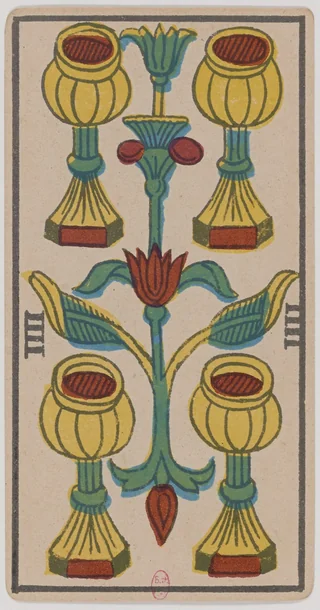
Quatre de Coupes — Lequart Besançon
Deck-native identity is shown first.
Rank-and-suit correspondence
Quatre de Coupes can emphasize building a stable frame and testing the limits that preserve it, expressed through receptivity, relationship, care, and emotional circulation. When excess, the same number-or-court structure can show stability that hardens into rigidity or closed circulation within receptivity, relationship, care, and emotional circulation.
Limit: This is a modern Venus number/rank-plus-suit synthesis, not a historical doctrine attributed to the Lequart maker. Read the pip or court structure directly; do not import an absent Rider–Waite–Smith narrative scene.
Sola Busca
Four of Cups — Sola Busca
Deck-native identity is shown first.
Rank-and-suit correspondence
The tending scene can emphasize care as labor, presence, and practical response to another person’s condition. Care can become overfunctioning, pressure, or self-erasure when consent and capacity are not checked.
Limit: This is a modern Venus image-led synthesis, not a historical Sola Busca divinatory doctrine. Do not import an absent Rider–Waite–Smith scene; the observed local image and rank/suit structure control the reflection.
Card identities, numbering, image mappings, and semantic claims have been checked against the cited sources and reviewed evidence. Each meaning is a modern reflective interpretation—not historical doctrine, a prediction, or proof of an outcome.
How to read Four of Cups in a real spread
Read this as a possible experience, not a diagnosis or private-state report. The question, orientation method, spread position, neighboring cards, actual options, consent, and circumstances are not supplied here.
Core layer
The card may foreground inward attention, disengagement, dissatisfaction, or reassessment when the reader is not ready to respond automatically.
Reading angle
Identify what feels unconvincing, what option is verifiably present, and what information is still missing. The pause may support discernment, but that has to be tested.
Reality check
The card cannot select itself, supply a spread position, prove a future event or private state, or replace direct evidence, consent, communication, emergency action, or qualified health, veterinary, legal, financial, mental-health, or safety help.
Four of Cups upright meaning
Upright, Four of Cups emphasizes a pause in engagement. Name what feels unconvincing, confirm the option that is actually available, and decide whether more information is needed before answering.
Four of Cups reversed meaning
If you use reversals, the primary reading is internalized: attention may turn so far inward that preferences and available choices become harder to state. A relevant alternative is distortion, when an idealized absent option or avoided feeling obscures what is present.
Four of Cups in love and feelings
In relationship questions, examine visible responsiveness, stated preferences, and willingness to engage. The card cannot reveal another person's dissatisfaction, rejection, private refusal, or intent to withdraw.
Four of Cups in work and decisions
At work, pause long enough to identify the real proposal, the terms that feel unconvincing, and the information needed to evaluate it. The card does not prove a missed offer, rejection, disengagement, or a hidden opinion.
Four of Cups in money and resources
For money decisions, confirm the offer, terms, budget, documents, and deadline before accepting or declining. Symbolic dissatisfaction is not evidence that an opportunity is bad, unavailable, or already missed.
Four of Cups as a Yes / No card
The yes/no answer is unclear until the actual option, preferences, and willingness to engage are verified. It can lean no only for an immediate response when information or genuine consent is missing.
Before any yes
Confirm what is truly being offered, what information is available, and whether the response is freely chosen.
Can lean no for now
An immediate answer is premature when the option is vague, information is missing, or consent is not genuine.
Tarot reader advice
Name the option that is actually available, the response it evokes, and one fact or conversation needed before accepting or declining. This keeps a pause from becoming an assumed rejection.
Four of Cups: identify the option before the response
Not responding immediately can be thoughtful, avoidant, or simply unfinished. The card does not decide which; it directs attention to the option, the preference, and the missing information.
Actual option
Write down only what has been clearly offered or made available.
Missing information
Name the fact or conversation required before a meaningful response is possible.
Pause or avoidance?
Ask whether inward attention clarifies a preference or makes available choices harder to see.
Source and limits
The Rider-Waite-Smith-named image asset is a local reference, not universal doctrine or proof of provenance, authorship, edition, or licensing. The card cannot diagnose apathy or depression, prove rejection, or reveal private dissatisfaction.
Use this card in a reading
Give the Four of Cups a real option to examine
If you continue with a spread, ask about a choice that actually exists and keep preferences, consent, and missing information visible in the question.
This public page provides the complete learning reference. A reading still needs a question, spread position, and context; it cannot supply a hidden rejection or paid-only knowledge of another person's feelings.