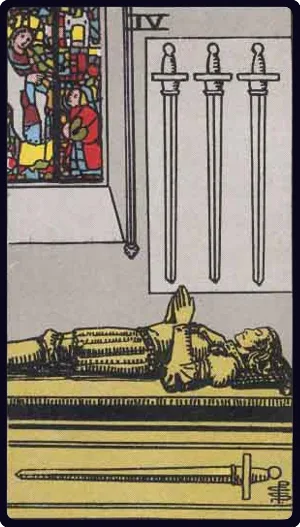
Four of Swords can foreground a deliberate pause, reduced mental pressure, and strategic non-action before a response or decision. The pause is useful only when it has a purpose, a boundary, and no conflict with urgent care, safety, or essential deadlines.
Choose a deck to see the card identity, number, image, relation type, and modern interpretive emphasis supported for that system.
Rider–Waite–Smith
Four of Swords — Rider–Waite–Smith
Deck-native identity is shown first.
Deck-native identity
Upright, Four of Swords emphasizes a bounded pause that protects attention and allows review. It remains appropriate only when it does not defer urgent care, safety action, legal deadlines, or essential responsibilities. If you use reversals, the primary reading is blocked: it may be hard to settle, pause, or reduce mental pressure enough to review clearly. A relevant alternative is excess, when rest or silence extends into avoidance, isolation, or indefinite delay.
Limit: This is a modern Venus synthesis based on the current canonical RWS-oriented reference page, not an ancient or universal doctrine. No individual visual cue is asserted in this brief; the local asset identity is known, while exact derivative provenance and rights remain unknown.
Lequart Besançon
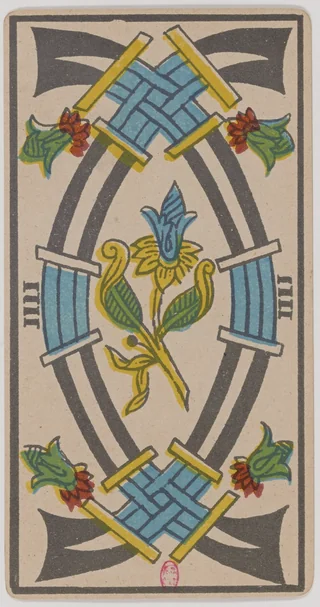
Quatre de Épées — Lequart Besançon
Deck-native identity is shown first.
Rank-and-suit correspondence
Quatre de Épées can emphasize building a stable frame and testing the limits that preserve it, expressed through discernment, conflict, decisions, and consequences. When excess, the same number-or-court structure can show stability that hardens into rigidity or closed circulation within discernment, conflict, decisions, and consequences.
Limit: This is a modern Venus number/rank-plus-suit synthesis, not a historical doctrine attributed to the Lequart maker. Read the pip or court structure directly; do not import an absent Rider–Waite–Smith narrative scene.
Sola Busca
Four of Swords — Sola Busca
Deck-native identity is shown first.
Rank-and-suit correspondence
The arrangement can emphasize concentrated thought, guarded awareness, and the need to rest inside a clear boundary. Guarded thought can become rumination, vigilance, or withdrawal from evidence that might revise the conclusion.
Limit: This is a modern Venus image-led synthesis, not a historical Sola Busca divinatory doctrine. Do not import an absent Rider–Waite–Smith scene; the observed local image and rank/suit structure control the reflection.
Card identities, numbering, image mappings, and semantic claims have been checked against the cited sources and reviewed evidence. Each meaning is a modern reflective interpretation—not historical doctrine, a prediction, or proof of an outcome.
How to read Four of Swords in a real spread
This reference does not diagnose why a pause is needed or predict what follows it. A personal reading still depends on the question, orientation method, spread position, neighboring cards, responsibilities, and real-world urgency.
Core layer
The card may foreground deliberate non-action that protects attention and creates room to review before responding.
Reading angle
Ask what the pause is for, how long it can safely last, and what condition will end it. Urgent care, safety action, or a legal deadline cannot be deferred for a card reading.
Reality check
The card cannot select itself, supply a spread position, prove a future event or private state, or replace direct evidence, consent, communication, emergency action, or qualified health, veterinary, legal, financial, mental-health, or safety help.
Four of Swords upright meaning
Upright, Four of Swords emphasizes a bounded pause that protects attention and allows review. It remains appropriate only when it does not defer urgent care, safety action, legal deadlines, or essential responsibilities.
Four of Swords reversed meaning
If you use reversals, the primary reading is blocked: it may be hard to settle, pause, or reduce mental pressure enough to review clearly. A relevant alternative is excess, when rest or silence extends into avoidance, isolation, or indefinite delay.
Four of Swords in love and feelings
In relationship questions, look for a stated need for time, clear boundaries, and a communication agreement about re-engaging. The card cannot prove ghosting, refusal, or another person's private reason for silence.
Four of Swords in work and decisions
At work, a short review window may help before a non-urgent decision. Set its purpose and deadline, but do not let symbolic permission to pause override contractual duties, safety procedures, or time-sensitive action.
Four of Swords in money and resources
For money or legal questions, a pause can create room to check documents and seek qualified advice. It cannot stop deadlines, guarantee recovery, or replace direct assessment of financial, legal, or care obligations.
Four of Swords as a Yes / No card
For a non-urgent immediate action, Four of Swords can lean no or indicate pause when review is needed. Health, safety, legal deadlines, and urgent care are not answerable by the card and require real-world assessment.
Pause when
The matter is non-urgent, review has a defined purpose, and a clear re-entry point is set.
Do not pause for Tarot
Care, safety, or a legal deadline requires action or qualified assessment now.
Tarot reader advice
Set a specific pause length, identify what will be reviewed, and state the condition or deadline for re-engaging. Act immediately when safety or care requires it.
Rest and delay are not interchangeable. This card becomes practical when the reader can explain the pause, limit its length, and name the responsibility that remains active.
Purpose
Name what reduced pressure will make possible: review, preparation, or a calmer response.
Time limit
Set a specific length and a deadline or condition for re-engaging.
Urgency check
Identify any care, safety, legal, or essential responsibility that prevents delay.
Source and limits
The Rider-Waite-Smith-named image asset is a local reference, not universal doctrine or proof of provenance, authorship, edition, or licensing. The card cannot diagnose illness or burnout, guarantee recovery, prescribe isolation, or prove refusal.
Use this card in a reading
Give the Four of Swords a bounded question
Use a spread only for a non-urgent reflection you can pause safely, and include the purpose, deadline, and re-entry condition in the question.
This public reference is complete for learning. A reading still needs a question, spread position, and context, and no report should delay urgent care, safety action, or a legal deadline.