Justice can frame facts, accountability, fairness, consequences, standards, and honest evaluation. It never gives a legal verdict, predicts a court outcome, establishes guilt or innocence, or replaces legal evidence or advice.
Choose a deck to see the card identity, number, image, relation type, and modern interpretive emphasis supported for that system.
Rider–Waite–Smith
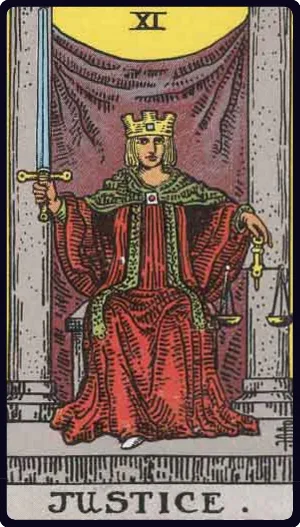
Justice — Rider–Waite–Smith
Deck-native identity is shown first.
Deck-native identity
Upright emphasizes a direct need for facts, standards, and responsibility. It does not establish that an outcome will be fair, favorable, or legally correct. Reversed, the primary lens is avoidance or distortion of accountability. Unfair pressure is one material alternative; the card does not prove injustice, corruption, or wrongdoing.
Limit: This is a modern Venus synthesis based on the current canonical RWS-oriented reference page, not an ancient or universal doctrine. No individual visual cue is asserted in this brief; the local asset identity is known, while exact derivative provenance and rights remain unknown.
Lequart Besançon
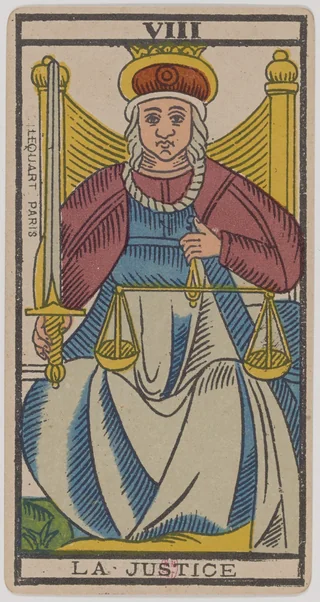
La Justice VIII — Lequart Besançon
Native identity: La Justice.
Meaning match, different number
La Justice VIII can emphasize proportion, evidence, and consequences that follow from a decision or agreement. Measurement can become punitive rigidity, selective evidence, or a demand for certainty where fair process is the real need.
Limit: This is La Justice VIII and uses strength.webp in the current asset set; do not label it XI or promise a legal outcome. This is a modern Venus synthesis informed by the observed Lequart/Besançon image; it is not presented as historical Marseille doctrine.
Sola Busca
Tulio XI — Sola Busca
Native identity: Tulio.
Ordinal comparison only
Tulio can emphasize deliberation, appeal, and the moment when a position must be made explicit enough to examine. Deliberation can become rhetorical defense or indefinite postponement when evidence and responsibility are avoided.
Limit: Tulio XI is an ordinal-only comparison, not a direct Justice identity; do not import scales or a sword. This is a modern Venus image-led reflection, not an original Sola Busca divinatory doctrine or a historical certainty.
Card identities, numbering, image mappings, and semantic claims have been checked against the cited sources and reviewed evidence. Each meaning is a modern reflective interpretation—not historical doctrine, a prediction, or proof of an outcome.
Move from fairness language to a factual record
This unpositioned reference cannot decide what is true or fair. Use it to identify the relevant facts, documents, responsibilities, standards, and consequences before choosing a clean process.
Core pattern
A decision may require evidence, accountable choices, a stated standard of fairness, and an honest review of consequences.
Position check
Advice asks for facts and clean process; obstacle may show avoidance or unfair pressure; outcome is only a conditional consequence path, not a verdict.
Reality check
Legal questions require jurisdiction-appropriate evidence and qualified legal advice. Tarot may only support reflection on the reader's process and choices.
Justice upright: evidence and accountable choice
Upright emphasizes a direct need for facts, standards, and responsibility. It does not establish that an outcome will be fair, favorable, or legally correct.
Justice reversed: avoided or distorted accountability
Reversed, the primary lens is avoidance or distortion of accountability. Unfair pressure is one material alternative; the card does not prove injustice, corruption, or wrongdoing.
Justice in love: compare standards with behavior
The card may help clarify expectations, responsibility, fairness, and consequences in a relationship. It cannot prove feelings, blame, guilt, or innocence. Use consent, direct communication, agreements, and observable behavior.
Justice in work: document the standard and the responsibility
Identify the decision, the governing expectation, the facts on record, and the responsibility within your control. The card does not establish wrongdoing or predict an employment or legal outcome.
Justice in money: let documents carry the weight
The card is not a price, debt, dispute, or court prediction. It may prompt a careful review of terms, records, responsibilities, and risk, while documents and qualified financial or legal advice guide consequential action.
Justice as a Yes / No card
Justice has no permanent yes or no value. Movement is more supportable when the relevant facts, standards, documents, and responsibilities are clear; reversed may call for review without proving that anyone acted wrongly.
Movement is more supported when
The evidence is available, the standard is clear, and the proposed action is accountable and within the reader's control.
Pause is more supported when
Documents are missing, responsibility is being avoided, or a symbolic fairness claim is being treated as a factual conclusion.
Gather the facts before naming the fair action
List the relevant documents, responsibilities, and standard of fairness. Then choose the cleanest action within your control. For legal decisions, use qualified counsel—not Tarot.
Justice becomes useful when “fair” is not left as a feeling. The reading should identify what evidence exists, what standard applies, and what accountable action is actually available.
Facts
What information or document is available, and what is still missing?
Standard
What stated rule, agreement, or measure of fairness applies?
Responsibility
Which part of the process belongs to the reader?
Action
What clean step can be taken without pretending Tarot has issued a verdict?
Apply the reference
Justice needs a real standard and factual record
Use a clearly labeled reading format only for reflection on a specific choice. A reading cannot replace evidence, counsel, or adjudication.
The public evidence-and-accountability meaning and legal boundary are complete here. No deeper reading can issue a verdict, predict court, establish guilt or innocence, prove wrongdoing, or replace legal advice.