Composure is not the absence of feeling, and it is not permission to control how someone else responds. King of Cups is a contextual stance for acknowledging emotional stakes while choosing proportionate expression, clear boundaries, and accountable action. It does not identify a mature man, counselor, healer, manager, or loving partner.
Choose a deck to see the card identity, number, image, relation type, and modern interpretive emphasis supported for that system.
Rider–Waite–Smith
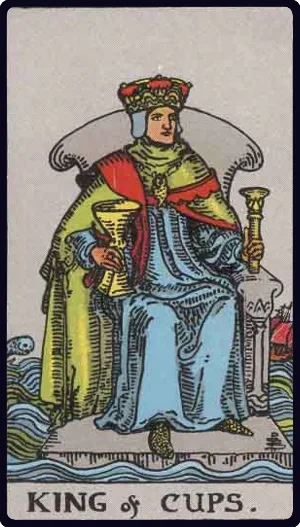
King of Cups — Rider–Waite–Smith
Deck-native identity is shown first.
Deck-native identity
Upright, King of Cups can support pausing, naming the emotional stakes, and responding in a way that neither suppresses feeling nor lets it dictate the outcome. The stance is useful when directness, boundaries, and accountability remain visible after the pause. Reversals are optional and method-dependent. The primary mode is distorted: emotional control becomes suppression, indirect influence, or mood-led decision-making presented as composure. The one material alternative is deficit: avoidance prevents direct engagement with relevant feeling. Neither mode is a diagnosis or proof of manipulation.
Limit: This is a modern Venus synthesis based on the current canonical RWS-oriented reference page, not an ancient or universal doctrine. No individual visual cue is asserted in this brief; the local asset identity is known, while exact derivative provenance and rights remain unknown.
Lequart Besançon
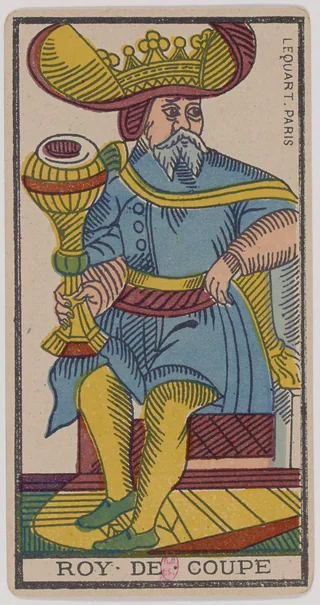
Roi de Coupes — Lequart Besançon
Deck-native identity is shown first.
Rank-and-suit correspondence
Roi de Coupes can emphasize setting direction, standards, and accountability for the suit’s use, expressed through receptivity, relationship, care, and emotional circulation. When excess, the same number-or-court structure can show governance that becomes domination, possession, or inflexible status defense within receptivity, relationship, care, and emotional circulation.
Limit: This is a modern Venus number/rank-plus-suit synthesis, not a historical doctrine attributed to the Lequart maker. Read the pip or court structure directly; do not import an absent Rider–Waite–Smith narrative scene.
Sola Busca
King of Cups — Sola Busca
Deck-native identity is shown first.
Rank-and-suit correspondence
This court role can emphasize accountable emotional governance: feeling is acknowledged while conduct remains deliberate. Governance can become status, control, or composure used to avoid honest exchange.
Limit: This is a modern Venus image-led synthesis, not a historical Sola Busca divinatory doctrine. Do not import an absent Rider–Waite–Smith scene; the observed local image and rank/suit structure control the reflection.
Card identities, numbering, image mappings, and semantic claims have been checked against the cited sources and reviewed evidence. Each meaning is a modern reflective interpretation—not historical doctrine, a prediction, or proof of an outcome.
King of Cups is a regulation check, not a personality label
No live-reading context exists on this page: there is no question, orientation choice, spread position, neighboring cards, or user circumstance. The reference can frame a response pattern, but it cannot tell you who someone is or what they privately feel.
Acknowledge the stakes
Name the feeling without asking it to decide the outcome. Emotional information belongs in the decision, alongside facts, consent, obligations, and the boundary that applies.
Choose accountable expression
A regulated response can be direct and still be bounded. It neither suppresses the relevant feeling nor uses that feeling to pressure, manage, or excuse conduct.
High-stakes stop line
The card cannot establish a health, pregnancy, pet-health, legal, financial, investing, mental-health, abuse, stalking, self-harm, emergency, threat, diagnosis, or safety fact or outcome. Use direct evidence, consent, emergency action, and qualified help as appropriate.
Method and source boundary
The King lens is a Venus Tarot interpretation, not universal rank doctrine, gender, status, or profession. The local image proves no suit-element, zodiac, visual, historical, provenance, edition, authorship, licensing, or textual-source claim.
King of Cups upright meaning
Upright, King of Cups can support pausing, naming the emotional stakes, and responding in a way that neither suppresses feeling nor lets it dictate the outcome. The stance is useful when directness, boundaries, and accountability remain visible after the pause.
King of Cups reversed meaning
Reversals are optional and method-dependent. The primary mode is distorted: emotional control becomes suppression, indirect influence, or mood-led decision-making presented as composure. The one material alternative is deficit: avoidance prevents direct engagement with relevant feeling. Neither mode is a diagnosis or proof of manipulation.
King of Cups in love and feelings
In relationships, examine observable regulation, direct communication, reciprocity, and repair. A calm presentation does not prove a private state or future behavior. King of Cups does not establish love, fidelity, maturity, calmness, healing, a partner's role, or anyone's feelings.
King of Cups in work and decisions
At work, name the emotional stake without letting it replace the actual decision criteria. Put the response beside the evidence, terms, authority, and boundary. The card does not identify a counselor, healer, manager, mediator, or any other profession, and it predicts no outcome.
King of Cups in money and resources
Strong feeling can shape a resource decision, but it cannot verify the numbers. Check the budget, documents, terms, and consequences, and seek qualified guidance where needed. Tarot does not validate an emotionally driven purchase, agreement, investment, or financial result.
King of Cups as a Yes / No card
The answer is unclear until the emotional stakes can be acknowledged without overriding facts, consent, or boundaries. It may lean yes for a regulated, direct, and accountable response. No court card has a permanent binary value; documents, qualified help, evidence, and safety take precedence over symbolism.
What supports the response
The feeling can be named, the facts remain intact, the boundary is respected, and the next step is direct rather than controlling.
What keeps it unclear
Composure is hiding avoidance, or emotion is quietly deciding the terms. Repeating the draw will not make the response more accountable.
Practical advice: separate feeling from decision
Name the feeling and the decision separately, pause, then choose one direct response that respects both the facts and the boundary. The pause creates room for regulation; it does not authorize guessing what another person feels.
The King of Cups lens asks whether composure supports a direct, bounded response—or hides avoidance, indirect influence, or a decision already made by the mood.
What feeling needs a name?
Acknowledge it as relevant without turning it into the decision.
What boundary applies?
Choose the limit that keeps expression proportionate and consent-respecting.
Is composure direct?
Look for a clear response rather than suppression, avoidance, or indirect pressure.
What stays unknown?
No love, fidelity, maturity, profession, healing, private feeling, or outcome is proven.
Put the emotional stake in context
A King of Cups reading can frame your response—not reveal another person's feelings
The complete approved meaning is public here. A spread may add question and position context, while observable conduct and direct communication remain decisive.
Use another format only to structure reflection. No deeper report turns King of Cups into proof of a man, partner, counselor, healer, manager, love, fidelity, maturity, healing, or private feelings.