Stewardship is visible in what a resource is for, who owns the obligation, and whether reserves protect long-term trust. King of Pentacles is a contextual stance for allocating responsibility under real limits. It is not proof of a wealthy man, father, boss, provider, property owner, secure partner, or successful business.
Choose a deck to see the card identity, number, image, relation type, and modern interpretive emphasis supported for that system.
Rider–Waite–Smith
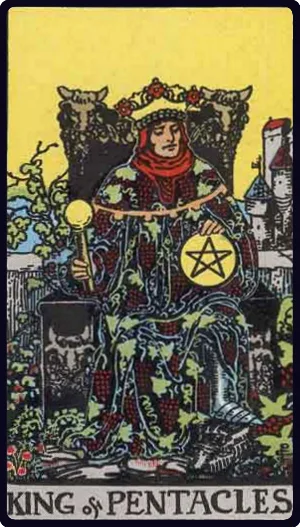
King of Pentacles — Rider–Waite–Smith
Deck-native identity is shown first.
Deck-native identity
Upright, King of Pentacles can support a conservative, documented allocation of time or resources with clear obligations, reserves, and review points. The aim is durable value under accountable limits—not accumulation, control, or status for its own sake. Reversals are optional and method-dependent. The primary mode is excess: control, status, accumulation, or risk avoidance displaces the resource's actual purpose and shared obligations. The one material alternative is deficit: weak stewardship, missing reserves, or unowned obligations undermine sustainability. Neither mode predicts loss or identifies a controlling person.
Limit: This is a modern Venus synthesis based on the current canonical RWS-oriented reference page, not an ancient or universal doctrine. No individual visual cue is asserted in this brief; the local asset identity is known, while exact derivative provenance and rights remain unknown.
Lequart Besançon
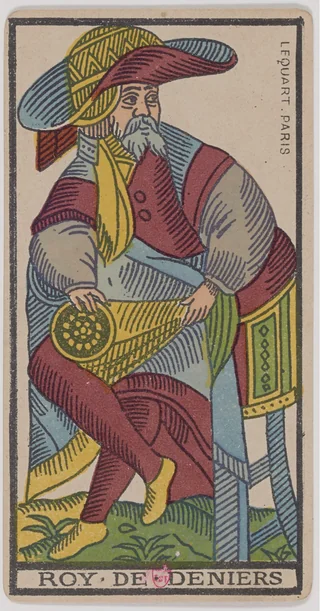
Roi de Deniers — Lequart Besançon
Deck-native identity is shown first.
Rank-and-suit correspondence
Roi de Deniers can emphasize setting direction, standards, and accountability for the suit’s use, expressed through resources, labor, material conditions, and sustainability. When excess, the same number-or-court structure can show governance that becomes domination, possession, or inflexible status defense within resources, labor, material conditions, and sustainability.
Limit: This is a modern Venus number/rank-plus-suit synthesis, not a historical doctrine attributed to the Lequart maker. Read the pip or court structure directly; do not import an absent Rider–Waite–Smith narrative scene.
Sola Busca
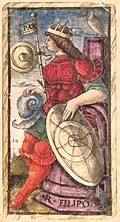
King of Coins — Sola Busca
Deck-native identity is shown first.
Rank-and-suit correspondence
This court role can emphasize governance of resources, standards, and long-term obligations. Governance can become possession, status defense, or inflexibility when conditions change.
Limit: This is a modern Venus image-led synthesis, not a historical Sola Busca divinatory doctrine. Do not import an absent Rider–Waite–Smith scene; the observed local image and rank/suit structure control the reflection.
Card identities, numbering, image mappings, and semantic claims have been checked against the cited sources and reviewed evidence. Each meaning is a modern reflective interpretation—not historical doctrine, a prediction, or proof of an outcome.
King of Pentacles is a stewardship test
This public reference has no question, orientation choice, spread position, neighboring cards, or user context. It can frame how resources and obligations are being handled, but it cannot identify a provider or promise wealth, work, property, security, health, or status.
Purpose before accumulation
Name what the resource is meant to protect or produce. More control or more reserves are not automatically better if they displace the resource's purpose and shared obligations.
Ownership and review
Make the owner, obligations, stakeholders, reserves, risks, and next review point concrete. Long-horizon trust depends on being able to inspect those choices.
High-stakes boundary
The card cannot establish a health, pregnancy, pet-health, legal, financial, investing, mental-health, abuse, stalking, self-harm, emergency, threat, diagnosis, or safety fact or outcome. Use direct evidence, consent, emergency action, and qualified help as appropriate.
Method and source boundary
The King lens is a Venus Tarot interpretation, not universal rank doctrine, gender, status, authority, or wealth. The image proves no suit-element, zodiac, visual, historical, provenance, edition, authorship, licensing, or textual-source claim.
King of Pentacles upright meaning
Upright, King of Pentacles can support a conservative, documented allocation of time or resources with clear obligations, reserves, and review points. The aim is durable value under accountable limits—not accumulation, control, or status for its own sake.
King of Pentacles reversed meaning
Reversals are optional and method-dependent. The primary mode is excess: control, status, accumulation, or risk avoidance displaces the resource's actual purpose and shared obligations. The one material alternative is deficit: weak stewardship, missing reserves, or unowned obligations undermine sustainability. Neither mode predicts loss or identifies a controlling person.
King of Pentacles in love and feelings
In relationships, examine shared obligations, resource decisions, reciprocity, and trust through observable agreements. Ask what each person has actually accepted and how the arrangement will be reviewed. King of Pentacles does not prove commitment, provision, status, property, security, or anyone's feelings.
King of Pentacles in work and decisions
For work, make ownership, obligations, capacity, reserves, risks, and review points visible before committing resources. The card cannot identify a boss, provider, owner, or executive, and it does not guarantee employment, business success, status, or a durable result.
King of Pentacles in money and resources
For money, property, or health-adjacent questions, verify budgets, ownership, documents, obligations, and risks with qualified advice. Tarot cannot establish wealth, property rights, investment value, financial security, or health. The actual record and applicable professional guidance come first.
King of Pentacles as a Yes / No card
King of Pentacles leans yes only when ownership, resources, reserves, obligations, and review are concrete. Otherwise it is unclear, or leans no when status or control is replacing stewardship. No court card has a permanent binary value; facts, consent, documents, qualified help, and safety outrank symbolism.
What supports yes
The resource has a stated purpose, ownership is documented, obligations and reserves are explicit, and a review point is scheduled.
What undermines the choice
Status, accumulation, or control has replaced the actual purpose, or obligations have no owner. Repeating the draw cannot create stewardship.
Practical advice: document the stewardship chain
List the resource, its purpose, owner, obligation, reserve, and next review point before committing it. This turns a broad idea of security into a record that can be checked against limits, stakeholders, and long-term trust.
The King of Pentacles lens becomes concrete when the resource, purpose, owner, obligation, reserve, and review point are visible enough for stakeholders to evaluate.
What is the resource for?
Define the value it should protect or produce before allocating it.
Which obligations are explicit?
Name the owner, stakeholders, risks, and reserves instead of relying on status.
How will trust be reviewed?
Set a date and standard for checking long-term sustainability.
What cannot be promised?
No provider, wealth, job, property, business success, security, health, or status is established.
Add a real resource question
Use King of Pentacles to examine stewardship—not to promise wealth or security
The complete approved meaning is public on this page. A spread can add position and context, while documents, ownership, reserves, and qualified advice still govern the real decision.
Continue only for structured context. No deeper format turns King of Pentacles into proof of a man, father, boss, provider, wealth, employment, property, business success, security, commitment, health, status, or money.