A sound decision should show its rule, its evidence, and who is allowed to challenge it. King of Swords is a contextual stance for applying standards consistently while making authority, uncertainty, and consequences visible. It does not identify a judge, lawyer, executive, expert, intelligent man, or objective truth.
Choose a deck to see the card identity, number, image, relation type, and modern interpretive emphasis supported for that system.
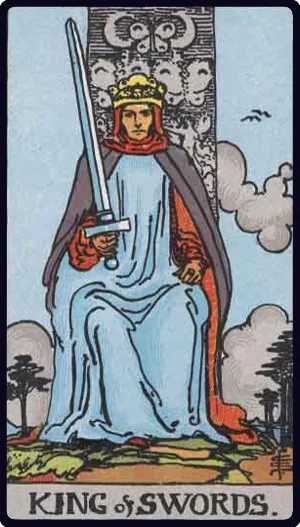
Rider–Waite–Smith
King of Swords — Rider–Waite–Smith
Deck-native identity is shown first.
Deck-native identity
Upright, King of Swords can support defining the decision rule, weighing relevant evidence, documenting reasons, and allowing challenge or review. The stance is strongest when uncertainty is named instead of hidden and authority stays within legitimate limits. Reversals are optional and method-dependent. The primary mode is distorted: reasoning is used selectively to rationalize power, conceal assumptions, or present opinion as settled fact. The only material alternative is excess: rigid rule application ignores material context, uncertainty, or humane consequences. Neither proves abuse of power.
Limit: This is a modern Venus synthesis based on the current canonical RWS-oriented reference page, not an ancient or universal doctrine. No individual visual cue is asserted in this brief; the local asset identity is known, while exact derivative provenance and rights remain unknown.
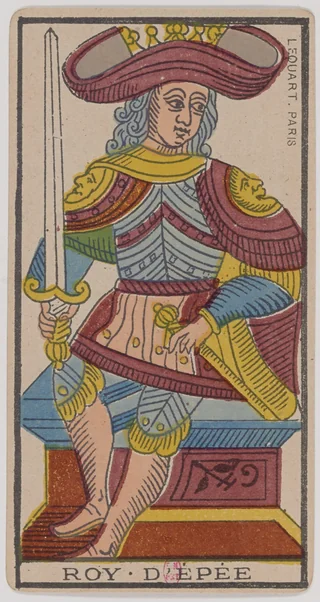
Lequart Besançon
Roi de Épées — Lequart Besançon
Deck-native identity is shown first.
Rank-and-suit correspondence
Roi de Épées can emphasize setting direction, standards, and accountability for the suit’s use, expressed through discernment, conflict, decisions, and consequences. When excess, the same number-or-court structure can show governance that becomes domination, possession, or inflexible status defense within discernment, conflict, decisions, and consequences.
Limit: This is a modern Venus number/rank-plus-suit synthesis, not a historical doctrine attributed to the Lequart maker. Read the pip or court structure directly; do not import an absent Rider–Waite–Smith narrative scene.
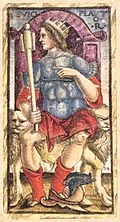
Sola Busca
King of Swords — Sola Busca
Deck-native identity is shown first.
Rank-and-suit correspondence
This court role can emphasize authority to decide and defend, provided evidence and accountability remain visible. Judgment can become verdict as power, intimidation, or refusal to revisit a flawed premise.
Limit: This is a modern Venus image-led synthesis, not a historical Sola Busca divinatory doctrine. Do not import an absent Rider–Waite–Smith scene; the observed local image and rank/suit structure control the reflection.
Card identities, numbering, image mappings, and semantic claims have been checked against the cited sources and reviewed evidence. Each meaning is a modern reflective interpretation—not historical doctrine, a prediction, or proof of an outcome.
King of Swords asks whether judgment is reviewable
This page supplies no question, selected orientation, spread position, neighboring cards, or user context. It can offer a standards-based decision lens, but it cannot establish authority, certify a conclusion, or decide a live case.
Make the criterion visible
State the rule before applying it. Then show which evidence is relevant, what remains uncertain, and whether the same standard is being used consistently.
Make power answerable
Authority needs a legitimate basis and a review path. A decision is not transparent if affected people cannot understand the reasons or challenge an error.
High-stakes limit
The card cannot establish a health, pregnancy, pet-health, legal, financial, investing, mental-health, abuse, stalking, self-harm, emergency, threat, diagnosis, or safety fact or outcome. Use direct evidence, consent, emergency action, and qualified help as appropriate.
Method and source limit
The King lens is a Venus Tarot interpretation, not universal rank doctrine, gender, status, intelligence, or professional authority. The image proves no suit-element, zodiac, visual, historical, provenance, edition, authorship, licensing, or textual-source claim.
King of Swords upright meaning
Upright, King of Swords can support defining the decision rule, weighing relevant evidence, documenting reasons, and allowing challenge or review. The stance is strongest when uncertainty is named instead of hidden and authority stays within legitimate limits.
King of Swords reversed meaning
Reversals are optional and method-dependent. The primary mode is distorted: reasoning is used selectively to rationalize power, conceal assumptions, or present opinion as settled fact. The only material alternative is excess: rigid rule application ignores material context, uncertainty, or humane consequences. Neither proves abuse of power.
King of Swords in love and feelings
In relationships, examine whether standards are mutual, reasons are transparent, and power is accountable. A rule that applies to only one person deserves scrutiny. King of Swords does not prove honesty, coldness, intelligence, authority, a partner's role, or anyone's feelings or motives.
King of Swords in work and decisions
For work, identify the decision criterion, relevant evidence, legitimate owner, uncertainty, and review path. The card cannot confer expertise, validate an executive decision, identify a profession, or guarantee a result. Real authority comes from the applicable role, policy, and law—not Tarot.
King of Swords in money and resources
For legal, health, financial, or contract questions, verify the evidence and authority with qualified professionals. Tarot cannot establish a diagnosis, contract meaning, legal result, liability, investment outcome, or objective truth. Keep the symbolic lens separate from the decision record.
King of Swords as a Yes / No card
The answer is unclear until evidence, decision criteria, authority, and consequences are verified. It may lean yes only for a transparent, reviewable decision within legitimate limits. No court card has a permanent binary value; facts, consent, documents, qualified help, and safety outrank symbolism.
Conditions for a lean yes
The rule is explicit, the evidence is relevant, authority is legitimate, uncertainty is recorded, and a real review path exists.
Conditions for pause
Opinion is presented as settled fact, power cannot be questioned, or context has been excluded by a rigid rule. Another draw cannot legitimize the decision.
Practical advice: write the review path
Write the decision criterion, supporting evidence, uncertainty, and who can review or challenge the conclusion. If no one can question it, that absence is part of the decision—not a detail to hide behind symbolic confidence.
The King of Swords lens makes judgment more accountable by exposing the rule, evidence, uncertainty, authority, and consequences to review.
What rule is applied?
State the criterion before using it to justify the result.
What remains uncertain?
Record gaps and competing evidence instead of smoothing them away.
Who can challenge it?
Name the legitimate reviewer and the path for correcting error.
What Tarot cannot certify
No expert, profession, authority, objective truth, diagnosis, contract meaning, or result is proven.
Add a defined decision context
Use King of Swords to examine judgment—not to certify authority or truth
This free page contains the complete approved meaning. A spread can add question and position context, while evidence, legitimate authority, and qualified review remain decisive.
Continue only to structure reflection. No deeper format turns King of Swords into proof of a man, judge, lawyer, executive, expert, intelligence, authority, objective truth, diagnosis, contract meaning, or legal result.