An appealing story can feel complete before reality has supplied the details. Knight of Cups is a contextual stance for expressing an emotionally or creatively meaningful intention, then checking sincerity, clarity, and follow-through against what has actually been communicated or done. It is not a messenger, admirer, proposal, apology, or promised offer.
Choose a deck to see the card identity, number, image, relation type, and modern interpretive emphasis supported for that system.
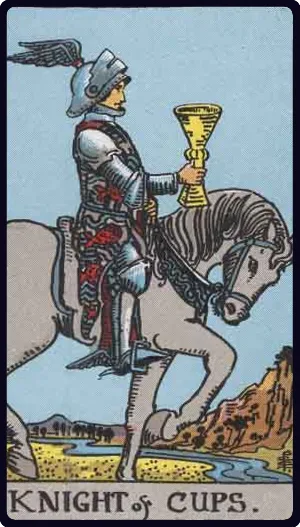
Rider–Waite–Smith
Knight of Cups — Rider–Waite–Smith
Deck-native identity is shown first.
Deck-native identity
Upright, Knight of Cups can invite you to articulate a value, feeling, or creative intention. The useful turn is to notice whether conduct matches the appealing idea. Sincerity becomes visible through clear language, consent-respecting action, and follow-through—not through symbolism alone. Reversals are optional and method-dependent. The primary mode here is distorted: idealization or wish-led interpretation obscures what has actually been said, offered, or done. The one material alternative is internalized: a meaningful response remains unexpressed on the reader's side and needs deliberate, consent-respecting articulation. This is not an automatic opposite.
Limit: This is a modern Venus synthesis based on the current canonical RWS-oriented reference page, not an ancient or universal doctrine. No individual visual cue is asserted in this brief; the local asset identity is known, while exact derivative provenance and rights remain unknown.
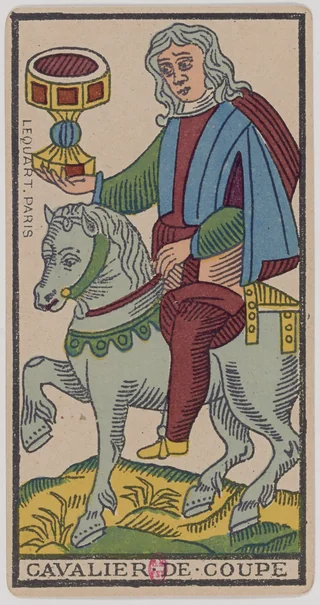
Lequart Besançon
Cavalier de Coupes — Lequart Besançon
Deck-native identity is shown first.
Rank-and-suit correspondence
Cavalier de Coupes can emphasize mobilizing the suit toward a defined task, message, or destination, expressed through receptivity, relationship, care, and emotional circulation. When excess, the same number-or-court structure can show movement that becomes haste, compulsion, or action without verification within receptivity, relationship, care, and emotional circulation.
Limit: This is a modern Venus number/rank-plus-suit synthesis, not a historical doctrine attributed to the Lequart maker. Read the pip or court structure directly; do not import an absent Rider–Waite–Smith narrative scene.
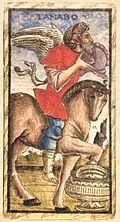
Sola Busca
Knight of Cups — Sola Busca
Deck-native identity is shown first.
Rank-and-suit correspondence
This court role can emphasize carrying feeling, invitation, or creative response into motion. Expression can become dramatization, projection, or pursuit of an ideal unsupported by behavior.
Limit: This is a modern Venus image-led synthesis, not a historical Sola Busca divinatory doctrine. Do not import an absent Rider–Waite–Smith scene; the observed local image and rank/suit structure control the reflection.
Card identities, numbering, image mappings, and semantic claims have been checked against the cited sources and reviewed evidence. Each meaning is a modern reflective interpretation—not historical doctrine, a prediction, or proof of an outcome.
Read Knight of Cups through expression and evidence
This page offers contextual possibilities, not a live reading. Without a question, orientation choice, spread position, neighboring cards, or user context, it cannot decide what is happening or what anyone will do.
The useful tension
Knight of Cups holds felt or creative intention beside a sincerity test. What has actually been communicated, and what observable follow-through would make the expression credible?
A Venus lens, not an identity
Here the rank is used as a Venus Tarot lens for an expressive mode. It is not a universal formula and cannot identify a person, gender, age, relationship role, profession, zodiac sign, or arrival.
Protect real-world decisions
The card cannot establish a health, pregnancy, pet-health, legal, financial, investing, mental-health, abuse, stalking, self-harm, emergency, threat, diagnosis, or safety fact or outcome. Use direct evidence, consent, emergency action, and qualified help as appropriate.
Source boundary
The local card image does not prove a suit-element or zodiac doctrine, visual meaning, history, provenance, edition, authorship, licensing, or versioned textual source.
Knight of Cups upright meaning
Upright, Knight of Cups can invite you to articulate a value, feeling, or creative intention. The useful turn is to notice whether conduct matches the appealing idea. Sincerity becomes visible through clear language, consent-respecting action, and follow-through—not through symbolism alone.
Knight of Cups reversed meaning
Reversals are optional and method-dependent. The primary mode here is distorted: idealization or wish-led interpretation obscures what has actually been said, offered, or done. The one material alternative is internalized: a meaningful response remains unexpressed on the reader's side and needs deliberate, consent-respecting articulation. This is not an automatic opposite.
Knight of Cups in love and feelings
For relationship questions, examine observable bids for connection, clarity, reciprocity, and follow-through. Ask whether words and conduct agree, and whether a direct question would be more useful than a romantic inference. Knight of Cups does not prove love, feelings, an admirer, a proposal, an apology, a date, or reconciliation.
Knight of Cups in work and decisions
A creative or values-led idea still needs scope, terms, and real commitment. Define what is being proposed, who owns the next step, and what would count as delivery. The card cannot announce an offer, job, message, collaboration, or favorable outcome.
Knight of Cups in money and resources
Feeling drawn to an idea is not a budget. Compare the emotional appeal with price, terms, documents, timing, and the resources actually available. Knight of Cups does not validate emotionally driven spending; use qualified financial or legal guidance when the decision calls for it.
Knight of Cups as a Yes / No card
The direction is unclear until words, actions, consent, and practical terms align. It may lean yes only for a transparent, reciprocal, reality-checked step. No court card has a permanent binary value, and facts, consent, documents, qualified help, and safety take priority over a symbolic tendency.
What supports a next step
A clear statement, an observable commitment, mutual consent, and terms that both sides can understand.
What keeps it unclear
Hope is doing the interpretive work while direct communication or practical details remain missing. Repeating the draw cannot supply them.
Practical advice: separate the story from the exchange
Write down the hoped-for story and what was actually communicated as two separate lines. Then identify one observable follow-through or one direct, consent-respecting question. That action stays with the reader; it does not claim access to anyone else's private state.
Emotional meaning belongs in the reading. The mistake is treating meaning as proof before communication and conduct have had a chance to confirm it.
What was expressed?
Use exact words and observable actions, not the version you hoped to hear.
What would show sincerity?
Name the follow-through that would make the intention concrete.
Which hope needs a question?
Ask directly when consent and clarity matter more than inference.
What cannot be concluded?
No card proves love, motive, identity, an offer, or a future event.
Add the missing context
Use Knight of Cups with a question—not as proof of a message or offer
The approved meaning is fully available on this free page. A spread can place the lens inside a question and position, but it cannot reveal another person's private feelings.
Choose another reading format only if you want structure for a real question. There is no paid-only Knight of Cups conclusion hidden beyond this reference.