Routine can build progress, or quietly replace it. Knight of Pentacles is a contextual stance for repeatable execution: define the obligation, resource it, measure it, and stay willing to adapt. The card does not identify a reliable person or guarantee a job, income, property, completion, or security.
Choose a deck to see the card identity, number, image, relation type, and modern interpretive emphasis supported for that system.
Rider–Waite–Smith
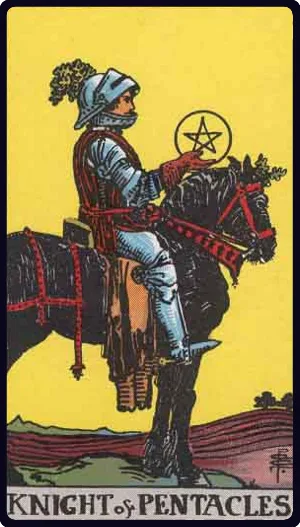
Knight of Pentacles — Rider–Waite–Smith
Deck-native identity is shown first.
Deck-native identity
Upright, Knight of Pentacles can favor breaking a practical aim into repeatable actions with realistic capacity, clear ownership, and checkpoints. The point is not slowness for its own sake. It is a method that can be performed again and evaluated honestly. Reversals are optional and method-dependent. The primary mode on this route is blocked: routine continues without meaningful progress, or the next practical step is stalled by missing capacity or information. The one material alternative is excess: process becomes rigid, perfectionistic, or detached from the actual goal. Neither mode predicts failure.
Limit: This is a modern Venus synthesis based on the current canonical RWS-oriented reference page, not an ancient or universal doctrine. No individual visual cue is asserted in this brief; the local asset identity is known, while exact derivative provenance and rights remain unknown.
Lequart Besançon
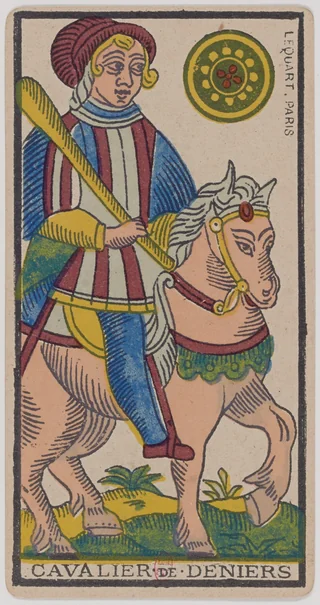
Cavalier de Deniers — Lequart Besançon
Deck-native identity is shown first.
Rank-and-suit correspondence
Cavalier de Deniers can emphasize mobilizing the suit toward a defined task, message, or destination, expressed through resources, labor, material conditions, and sustainability. When excess, the same number-or-court structure can show movement that becomes haste, compulsion, or action without verification within resources, labor, material conditions, and sustainability.
Limit: This is a modern Venus number/rank-plus-suit synthesis, not a historical doctrine attributed to the Lequart maker. Read the pip or court structure directly; do not import an absent Rider–Waite–Smith narrative scene.
Sola Busca
Knight of Coins — Sola Busca
Deck-native identity is shown first.
Rank-and-suit correspondence
This court role can emphasize steady transport of value and protection of resources across a real journey. Steadiness can become delay, overprotection, or movement so cautious that purpose is lost.
Limit: This is a modern Venus image-led synthesis, not a historical Sola Busca divinatory doctrine. Do not import an absent Rider–Waite–Smith scene; the observed local image and rank/suit structure control the reflection.
Card identities, numbering, image mappings, and semantic claims have been checked against the cited sources and reviewed evidence. Each meaning is a modern reflective interpretation—not historical doctrine, a prediction, or proof of an outcome.
Knight of Pentacles asks whether the method still works
This reference has no selected orientation and no specific question, spread position, neighboring cards, or user context. It can describe a methodical decision mode, but it cannot produce a verdict or tell you who someone is.
Define the obligation
Name the task, owner, available capacity, schedule, and evidence that will count as progress. “Keep going” is not a plan until those pieces are visible.
Keep the method adjustable
Consistency is useful when it serves the goal. If the checkpoint shows no meaningful progress, the route may need new information, added capacity, or a different process.
Do not outsource safety
The card cannot establish a health, pregnancy, pet-health, legal, financial, investing, mental-health, abuse, stalking, self-harm, emergency, threat, diagnosis, or safety fact or outcome. Use direct evidence, consent, emergency action, and qualified help as appropriate.
Know the source boundary
The rank lens is a Venus Tarot interpretation rather than universal doctrine. The local image does not establish a suit-element or zodiac formula, visual meaning, history, provenance, edition, authorship, licensing, or a versioned textual source.
Knight of Pentacles upright meaning
Upright, Knight of Pentacles can favor breaking a practical aim into repeatable actions with realistic capacity, clear ownership, and checkpoints. The point is not slowness for its own sake. It is a method that can be performed again and evaluated honestly.
Knight of Pentacles reversed meaning
Reversals are optional and method-dependent. The primary mode on this route is blocked: routine continues without meaningful progress, or the next practical step is stalled by missing capacity or information. The one material alternative is excess: process becomes rigid, perfectionistic, or detached from the actual goal. Neither mode predicts failure.
Knight of Pentacles in love and feelings
In a relationship context, examine observable consistency, shared responsibilities, and whether routines support both people. A repeated action can be discussed; a private feeling cannot be inferred. Knight of Pentacles does not prove loyalty, commitment, reliability, or a future partner.
Knight of Pentacles in work and decisions
Put the actual task on the page: required skill, owner, schedule, available capacity, and next checkpoint. That turns a broad intention into work that can be monitored and adjusted. The card cannot guarantee employment, an offer, completion, advancement, or a successful result.
Knight of Pentacles in money and resources
For resources, inspect the budget, obligation, recurring cost, documents, and measurement plan. A familiar routine may still be unaffordable or ineffective. Use qualified financial or legal guidance where needed; Knight of Pentacles does not promise income, property, or material security.
Knight of Pentacles as a Yes / No card
Knight of Pentacles leans yes only when the obligation is specific, resourced, repeatable, and measurable. Otherwise it remains unclear, or leans no when routine is masking stalled progress. No court card has a permanent binary value, and facts, consent, documents, qualified help, and safety outrank the symbolic direction.
Evidence for a lean yes
The task has an owner, the capacity exists, the process can be repeated, and a checkpoint will show whether it works.
Evidence for a pause
The routine is continuing because it is familiar, not because results support it. Do not use another draw to avoid revising the method.
Practical advice: build the next checkpoint
Define one repeatable task, its owner, available capacity, and the next evidence-based checkpoint. If the checkpoint fails, treat that as information about the method—not as a symbolic judgment about a person.
The core question is not whether persistence sounds admirable. It is whether a resourced, repeatable action is producing evidence of progress and can change when the evidence says it should.
Which step is resourced?
Choose an action the available time, skill, and budget can actually support.
What shows progress?
Set a checkpoint with evidence, not a vague sense of being busy.
Where should routine adapt?
Keep the goal stable enough to measure while allowing the method to change.
What is outside the card?
No identity, job, income, property, commitment, or outcome is established here.
Move from reference to context
A real question can test the Knight of Pentacles method
This free page gives the complete approved meaning. A spread can supply a position and surrounding context, but it cannot promise the practical outcome you want.
Use another format for context, not certainty. No paid or free draw turns this card into proof of a person, job, offer, completion, property, income, or security.