A fast answer can still be the wrong answer. Knight of Swords is a contextual lens for rapid reasoning or forceful communication, tested by accuracy, listening, and consequences. It does not predict conflict, news, legal action, an attack, or victory—and it is never proof of an aggressive or honest person.
Choose a deck to see the card identity, number, image, relation type, and modern interpretive emphasis supported for that system.
Rider–Waite–Smith
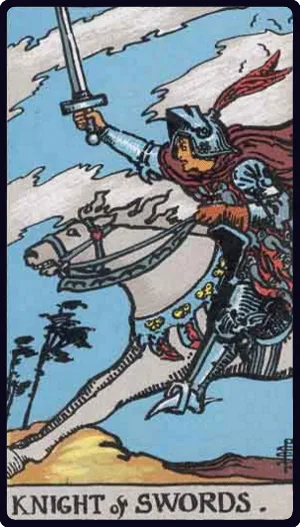
Knight of Swords — Rider–Waite–Smith
Deck-native identity is shown first.
Deck-native identity
Upright, Knight of Swords can support naming the issue and advancing a reasoned argument. The condition matters: claims need checking, and the response needs to remain proportionate. Clarity is not the same thing as certainty, especially when new evidence could change the conclusion. Reversals are optional and method-dependent. The primary mode is excess: speed, certainty, or argument overwhelms listening, nuance, and verification. The only material alternative is deficit: overanalysis or fear of conflict prevents a necessary, bounded response. Neither is a universal opposite or a forecast.
Limit: This is a modern Venus synthesis based on the current canonical RWS-oriented reference page, not an ancient or universal doctrine. No individual visual cue is asserted in this brief; the local asset identity is known, while exact derivative provenance and rights remain unknown.
Lequart Besançon
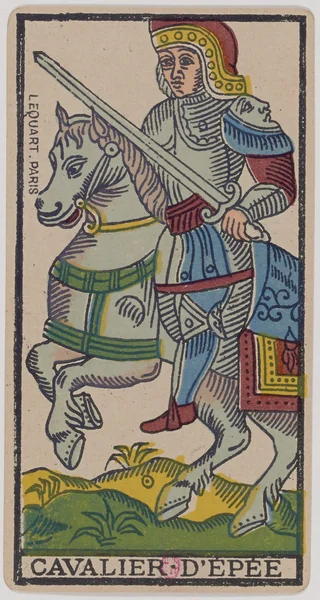
Cavalier de Épées — Lequart Besançon
Deck-native identity is shown first.
Rank-and-suit correspondence
Cavalier de Épées can emphasize mobilizing the suit toward a defined task, message, or destination, expressed through discernment, conflict, decisions, and consequences. When excess, the same number-or-court structure can show movement that becomes haste, compulsion, or action without verification within discernment, conflict, decisions, and consequences.
Limit: This is a modern Venus number/rank-plus-suit synthesis, not a historical doctrine attributed to the Lequart maker. Read the pip or court structure directly; do not import an absent Rider–Waite–Smith narrative scene.
Sola Busca
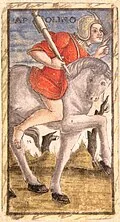
Knight of Swords — Sola Busca
Deck-native identity is shown first.
Rank-and-suit correspondence
This court role can emphasize decisive engagement with a defined problem or argument. Decisiveness can become attack, speed without listening, or certainty before verification.
Limit: This is a modern Venus image-led synthesis, not a historical Sola Busca divinatory doctrine. Do not import an absent Rider–Waite–Smith scene; the observed local image and rank/suit structure control the reflection.
Card identities, numbering, image mappings, and semantic claims have been checked against the cited sources and reviewed evidence. Each meaning is a modern reflective interpretation—not historical doctrine, a prediction, or proof of an outcome.
Use Knight of Swords to test a response
A static card page cannot settle a dispute. No question, orientation choice, spread position, neighboring cards, or user context is present, so this page defines possible reasoning patterns rather than a person, event, or verdict.
Central test
What claim is driving the response? Check the evidence for and against it before speed or confidence turns an interpretation into an assumed fact.
Communication test
Directness is useful only when it remains proportionate. Listening, tone, boundaries, and the likely consequences belong in the decision alongside the argument.
High-stakes limit
The card cannot establish a health, pregnancy, pet-health, legal, financial, investing, mental-health, abuse, stalking, self-harm, emergency, threat, diagnosis, or safety fact or outcome. Use direct evidence, consent, emergency action, and qualified help as appropriate.
Interpretive source limit
This is a Venus Tarot court-card lens, not a universal rank formula. The local image supplies no suit-element or zodiac doctrine, visual symbolism, history, provenance, edition, authorship, licensing, or versioned textual source.
Knight of Swords upright meaning
Upright, Knight of Swords can support naming the issue and advancing a reasoned argument. The condition matters: claims need checking, and the response needs to remain proportionate. Clarity is not the same thing as certainty, especially when new evidence could change the conclusion.
Knight of Swords reversed meaning
Reversals are optional and method-dependent. The primary mode is excess: speed, certainty, or argument overwhelms listening, nuance, and verification. The only material alternative is deficit: overanalysis or fear of conflict prevents a necessary, bounded response. Neither is a universal opposite or a forecast.
Knight of Swords in love and feelings
In relationship contexts, examine the pace and tone of actual communication. Is listening present? Are boundaries being respected? This card does not prove conflict, aggression, betrayal, honesty, or anyone's intent. Use direct conversation and observed conduct instead of assigning a private motive.
Knight of Swords in work and decisions
At work, identify the central claim, the person authorized to act, the deadline, and the consequences of getting it wrong. A swift response may be appropriate when it is evidence-based and revisable. Knight of Swords does not predict a message, contract result, confrontation, job change, or win.
Knight of Swords in money and resources
For money or legal-adjacent questions, verify the documents, numbers, terms, authority, and deadlines. Do not let the card stand in for contract interpretation, financial advice, or a risk assessment. Qualified help and the actual record outrank any symbolic impression.
Knight of Swords as a Yes / No card
The answer is unclear until the central claim is verified and the consequences are considered. It may lean yes only for a proportionate, evidence-based response with room to revise. No court card has a permanent binary value; facts, consent, documents, qualified help, and safety outrank symbolism.
A defensible lean yes
The evidence supports the claim, the response fits the stakes, and a correction remains possible if better information appears.
A reason to pause
Certainty is moving faster than verification, or fear of conflict is preventing a bounded reply. Another draw cannot repair either problem.
Practical advice: audit the claim before the reply
State the claim in one sentence, list the evidence for and against it, and delay the response long enough to check tone and consequences. That pause is not avoidance; it is a way to keep speed from deciding what the facts mean.
This card earns its place when it turns urgency into a better test: verify the statement, right-size the response, and notice the consequence that speed makes easy to miss.
What needs verification?
Separate the claim itself from the confidence with which it was delivered.
What is proportionate?
Match the tone and scope of the response to evidence and actual stakes.
What could speed miss?
Look for a consequence, listener, or material fact the first argument excluded.
What stays unknown?
The card cannot establish intent, objective truth, conflict, news, or an outcome.
Give the claim a position
A spread can organize the question; it cannot make Knight of Swords objective proof
This free page contains the approved interpretation. A reading adds question and position context, while evidence and legitimate authority still decide real-world claims.
Continue only if a defined question would help. No deeper format turns this card into proof of a person, message, conflict, contract, legal result, attack, or victory.