Starting is rarely the hard part here. Knight of Wands is a contextual lens for energized pursuit, with the real test arriving in pace, preparation, and follow-through. It does not identify an adventurous person or promise that movement, travel, an offer, or success is on the way.
Choose a deck to see the card identity, number, image, relation type, and modern interpretive emphasis supported for that system.
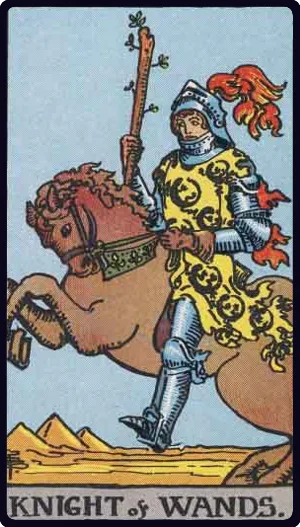
Rider–Waite–Smith
Knight of Wands — Rider–Waite–Smith
Deck-native identity is shown first.
Deck-native identity
Upright, Knight of Wands can foreground a willingness to initiate or re-engage. That willingness matters only if speed serves a defined aim and the effort can be sustained responsibly. A strong first move without a workable second move is still useful information. Reversals are optional and method-dependent. The primary reversed mode on this page is excess: urgency, stimulation, or performance outruns preparation and accountability. One material alternative is deficit: energy is scattered or cannot yet be translated into a workable next step. Neither mode is an automatic opposite or a prediction.
Limit: This is a modern Venus synthesis based on the current canonical RWS-oriented reference page, not an ancient or universal doctrine. No individual visual cue is asserted in this brief; the local asset identity is known, while exact derivative provenance and rights remain unknown.
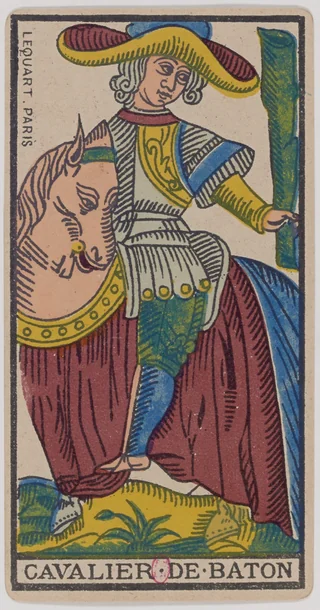
Lequart Besançon
Cavalier de Bâtons — Lequart Besançon
Deck-native identity is shown first.
Rank-and-suit correspondence
Cavalier de Bâtons can emphasize mobilizing the suit toward a defined task, message, or destination, expressed through initiative, effort, enterprise, and direction. When excess, the same number-or-court structure can show movement that becomes haste, compulsion, or action without verification within initiative, effort, enterprise, and direction.
Limit: This is a modern Venus number/rank-plus-suit synthesis, not a historical doctrine attributed to the Lequart maker. Read the pip or court structure directly; do not import an absent Rider–Waite–Smith narrative scene.
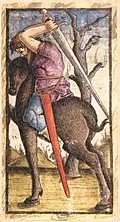
Sola Busca
Knight of Batons — Sola Busca
Deck-native identity is shown first.
Rank-and-suit correspondence
This court role can emphasize mobilized initiative and the capacity to carry action into changing terrain. Momentum can become a charge without control, recovery, or a verified destination.
Limit: This is a modern Venus image-led synthesis, not a historical Sola Busca divinatory doctrine. Do not import an absent Rider–Waite–Smith scene; the observed local image and rank/suit structure control the reflection.
Card identities, numbering, image mappings, and semantic claims have been checked against the cited sources and reviewed evidence. Each meaning is a modern reflective interpretation—not historical doctrine, a prediction, or proof of an outcome.
Knight of Wands is a pace check, not a person
This free reference describes interpretive possibilities. No question, orientation choice, spread position, neighboring cards, or user context has been supplied, so it cannot produce an individualized reading or fixed verdict.
Core lens
Use Knight of Wands to examine energized initiative: what the action is for, how quickly it is moving, and whether someone can own the next step without outrunning preparation.
Context changes the use
In a real spread, the exact question, chosen orientation method, position, surrounding cards, observable facts, and available choices determine how this stance applies.
Safety comes first
The card cannot establish a health, pregnancy, pet-health, legal, financial, investing, mental-health, abuse, stalking, self-harm, emergency, threat, diagnosis, or safety fact or outcome. Use direct evidence, consent, emergency action, and qualified help as appropriate.
Method and source limit
This court-card lens is a Venus Tarot interpretation, not a universal rank formula. The page image is a local asset; it does not establish a suit-element or zodiac doctrine, history, provenance, edition, authorship, licensing, visual symbolism, or a versioned textual source.
Knight of Wands upright meaning
Upright, Knight of Wands can foreground a willingness to initiate or re-engage. That willingness matters only if speed serves a defined aim and the effort can be sustained responsibly. A strong first move without a workable second move is still useful information.
Knight of Wands reversed meaning
Reversals are optional and method-dependent. The primary reversed mode on this page is excess: urgency, stimulation, or performance outruns preparation and accountability. One material alternative is deficit: energy is scattered or cannot yet be translated into a workable next step. Neither mode is an automatic opposite or a prediction.
Knight of Wands in love and feelings
In a relationship context, look at visible initiative, pace, consistency, and respect for consent. A burst of attention is not the same as dependable participation. This card does not prove attraction, passion, an invitation, or anyone's feelings, and it cannot identify a partner, rival, admirer, or arriving person.
Knight of Wands in work and decisions
For work, compare enthusiasm with scope, capacity, risk limits, and a concrete follow-through plan. Ask who owns the next task, what preparation is missing, and when the plan will be reviewed. Knight of Wands does not announce a launch, job, opportunity, trip, or successful outcome.
Knight of Wands in money and resources
When resources are involved, energy is not evidence of affordability or acceptable risk. Put the idea beside the budget, terms, documents, deadlines, and downside limit. Use qualified financial or legal guidance when the stakes require it; the card cannot validate an investment or predict a material result.
Knight of Wands as a Yes / No card
Knight of Wands leans yes only when the aim is defined, facts and consent support action, and the first step has an owner and limit. Otherwise the answer is unclear, or it leans no when urgency is substituting for readiness. No court card has a permanent binary value, and facts, consent, documents, qualified help, and safety outrank symbolism.
Before a conditional yes
Name the intended result, the accountable owner, and the pace or risk limit. If any of those are missing, the next task is clarification rather than acceleration.
When to stop asking
Do not repeat the draw to force a stronger answer. Pause and choose an observable action that can confirm readiness in the real situation.
Practical advice: give the energy a container
Write the intended outcome, the smallest accountable next step, and one pace or risk limit before acting. This keeps the reading on a decision you can control instead of turning momentum into a promise.
The value of this card is not raw intensity. It is the chance to make initiative specific enough to evaluate before momentum sets the terms.
What is the action for?
State the outcome in language that can later be checked.
Can the pace hold?
Look for preparation, available capacity, and evidence that a second step is possible.
What keeps it accountable?
Choose a limit that prevents enthusiasm from deciding everything.
What remains unknown?
The card alone supplies no event, outcome, person, or private state.
Put the reference in context
A reading adds a question and position—not a hidden Knight of Wands meaning
This page contains the complete approved public meaning. If you continue, choose a format that gives the card an actual question, position, and surrounding context.
The free reference stands on its own. A reading may apply it to a question, but it cannot turn the card into proof of a person, trip, message, offer, job, conflict, or future event.