A clear boundary should be able to name its evidence and its impact. Queen of Swords is a contextual stance for separating relevant facts from assumption and communicating a proportionate standard without erasing emotional context. It is not proof of a cold, honest, independent, divorced, or professional woman.
Choose a deck to see the card identity, number, image, relation type, and modern interpretive emphasis supported for that system.
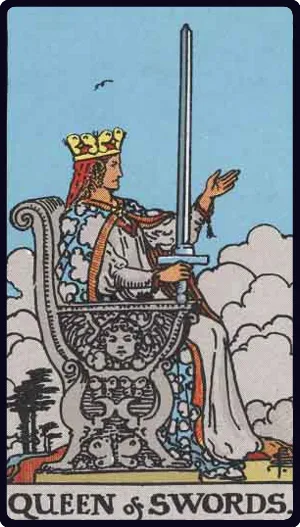
Rider–Waite–Smith
Queen of Swords — Rider–Waite–Smith
Deck-native identity is shown first.
Deck-native identity
Upright, Queen of Swords can support a candid, bounded statement grounded in relevant facts, consistent criteria, and awareness of impact. The aim is not bluntness. It is clarity that another person can understand, question, and correct if the evidence changes. Reversals are optional and method-dependent. The primary mode is distorted: discernment hardens into harsh judgment, defensive certainty, or selective use of evidence. The one material alternative is internalized: a necessary boundary or question is withheld to avoid discomfort. Neither mode proves cruelty, dishonesty, or a fixed personality.
Limit: This is a modern Venus synthesis based on the current canonical RWS-oriented reference page, not an ancient or universal doctrine. No individual visual cue is asserted in this brief; the local asset identity is known, while exact derivative provenance and rights remain unknown.
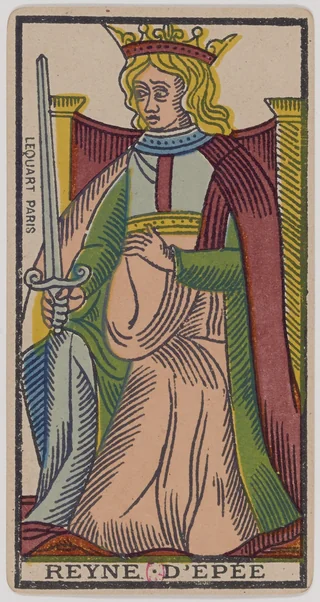
Lequart Besançon
Reine de Épées — Lequart Besançon
Deck-native identity is shown first.
Rank-and-suit correspondence
Reine de Épées can emphasize holding and stewarding the suit with receptive but accountable command, expressed through discernment, conflict, decisions, and consequences. When internalized, the same number-or-court structure can show stewardship that becomes overholding, indirect control, or unsupported emotional labor within discernment, conflict, decisions, and consequences.
Limit: This is a modern Venus number/rank-plus-suit synthesis, not a historical doctrine attributed to the Lequart maker. Read the pip or court structure directly; do not import an absent Rider–Waite–Smith narrative scene.
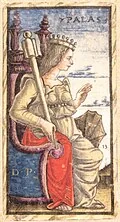
Sola Busca
Queen of Swords — Sola Busca
Deck-native identity is shown first.
Rank-and-suit correspondence
This court role can emphasize disciplined judgment, pattern recognition, and clarity joined to responsibility. Clarity can become guardedness, abstraction, or standards that no human situation can meet.
Limit: This is a modern Venus image-led synthesis, not a historical Sola Busca divinatory doctrine. Do not import an absent Rider–Waite–Smith scene; the observed local image and rank/suit structure control the reflection.
Card identities, numbering, image mappings, and semantic claims have been checked against the cited sources and reviewed evidence. Each meaning is a modern reflective interpretation—not historical doctrine, a prediction, or proof of an outcome.
Queen of Swords is a discipline of discernment
This static reference has no question, selected orientation, spread position, neighboring cards, or user context. It can offer a decision lens, but it cannot establish objective truth, identify a person, or produce an individualized verdict.
Evidence before judgment
Ask which facts are relevant, which statements are interpretations, and what remains uncertain. A forceful conclusion does not become more accurate because it sounds clean.
Boundary with impact
A useful boundary is specific, mutual where relevant, and proportionate to the evidence. Emotional context can inform how it is communicated without deciding whether the underlying claim is true.
Safety and authority limit
The card cannot establish a health, pregnancy, pet-health, legal, financial, investing, mental-health, abuse, stalking, self-harm, emergency, threat, diagnosis, or safety fact or outcome. Use direct evidence, consent, emergency action, and qualified help as appropriate.
Interpretive and source limit
The Queen lens is a Venus Tarot interpretation, not a universal rank formula or gender. The page image supplies no suit-element, zodiac, visual, historical, provenance, edition, authorship, licensing, or textual doctrine.
Queen of Swords upright meaning
Upright, Queen of Swords can support a candid, bounded statement grounded in relevant facts, consistent criteria, and awareness of impact. The aim is not bluntness. It is clarity that another person can understand, question, and correct if the evidence changes.
Queen of Swords reversed meaning
Reversals are optional and method-dependent. The primary mode is distorted: discernment hardens into harsh judgment, defensive certainty, or selective use of evidence. The one material alternative is internalized: a necessary boundary or question is withheld to avoid discomfort. Neither mode proves cruelty, dishonesty, or a fixed personality.
Queen of Swords in love and feelings
In relationships, examine what was actually said, whether standards apply mutually, and whether a boundary is clear and proportionate. Direct communication matters more than character labels. Queen of Swords does not prove betrayal, coldness, honesty, independence, legal status, or anyone's feelings or motives.
Queen of Swords in work and decisions
For work, define the criterion before applying it. Record the relevant evidence, the decision owner, and the path for correction or challenge. The card does not establish intelligence, authority, professional status, objective truth, or a favorable outcome.
Queen of Swords in money and resources
For financial or legal-adjacent choices, distinguish the document from your interpretation of it. Verify terms, numbers, dates, and legitimate authority with qualified help where needed. Tarot cannot interpret a contract, establish liability, diagnose a problem, or decide the outcome.
Queen of Swords as a Yes / No card
The answer remains unclear until the relevant facts and standard are explicit. It may lean yes only when the boundary or decision is evidence-based, proportionate, and open to correction. No court card has a permanent binary value; facts, consent, documents, qualified help, and safety outrank symbolism.
What supports a lean yes
The standard is stated in advance, the evidence is relevant, the impact is proportionate, and there is a way to correct an error.
What requires more work
Opinion is being presented as fact, or a needed boundary remains unspoken. Repeating the question to Tarot will not resolve either issue.
Practical advice: write three honest lines
Separate facts, interpretations, and feelings into three lines, then state one proportionate boundary or question. This simple format makes it harder to hide an assumption inside a confident conclusion.
The Queen of Swords lens is strongest when a boundary can be explained without pretending that every interpretation is a fact or that emotional impact is irrelevant.
Which facts matter?
Keep the record separate from inference and selective emphasis.
What boundary fits?
Choose a response proportionate to the evidence and actual impact.
How is dignity preserved?
Be candid without using clarity as permission for contempt.
What cannot be proven?
The card establishes no betrayal, honesty, authority, legal status, identity, or outcome.
Put the standard in context
A Queen of Swords reading can organize discernment, not certify truth
This page contains the complete approved public meaning. A spread adds a question and position; documents, evidence, and qualified authority decide real-world claims.
Continue for context only. No reading can turn Queen of Swords into proof of a woman, betrayal, honesty, legal status, intelligence, authority, diagnosis, or objective truth.