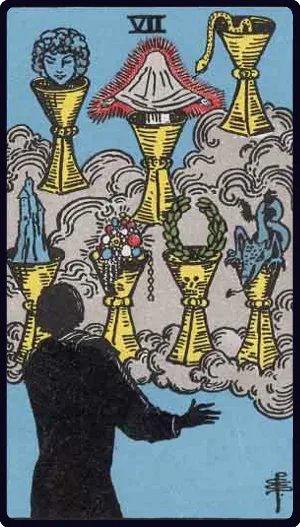
Seven of Cups can foreground several possibilities or projections at once. Its job is not to label the reader confused or deceived; it is to separate what is available, imagined, desired, and supported by evidence.
Choose a deck to see the card identity, number, image, relation type, and modern interpretive emphasis supported for that system.
Rider–Waite–Smith
Seven of Cups — Rider–Waite–Smith
Deck-native identity is shown first.
Deck-native identity
Upright, name the options without committing to their reality, then test each against evidence, consequences, feasibility, and values. If you use reversals, the primary mode is release: attention may be narrowing from many imagined paths toward one evidence-backed choice. The only material alternative is distorted, when idealization or option overload continues to prevent comparison.
Limit: This is a modern Venus synthesis based on the current canonical RWS-oriented reference page, not an ancient or universal doctrine. No individual visual cue is asserted in this brief; the local asset identity is known, while exact derivative provenance and rights remain unknown.
Lequart Besançon
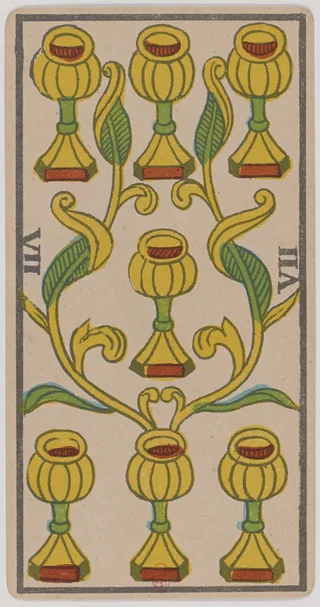
Sept de Coupes — Lequart Besançon
Deck-native identity is shown first.
Rank-and-suit correspondence
Sept de Coupes can emphasize testing autonomy, resilience, and the strength of a chosen method, expressed through receptivity, relationship, care, and emotional circulation. When excess, the same number-or-court structure can show self-protection that becomes strain, defensiveness, or isolation within receptivity, relationship, care, and emotional circulation.
Limit: This is a modern Venus number/rank-plus-suit synthesis, not a historical doctrine attributed to the Lequart maker. Read the pip or court structure directly; do not import an absent Rider–Waite–Smith narrative scene.
Sola Busca
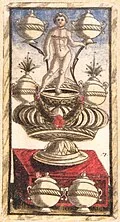
Seven of Cups — Sola Busca
Deck-native identity is shown first.
Rank-and-suit correspondence
The elevated figure can emphasize maintaining poise among several emotional or imaginative possibilities. Possibility can become display, fantasy, or unstable choice when no option is tested against real conditions.
Limit: This is a modern Venus image-led synthesis, not a historical Sola Busca divinatory doctrine. Do not import an absent Rider–Waite–Smith scene; the observed local image and rank/suit structure control the reflection.
Card identities, numbering, image mappings, and semantic claims have been checked against the cited sources and reviewed evidence. Each meaning is a modern reflective interpretation—not historical doctrine, a prediction, or proof of an outcome.
How to read Seven of Cups in a real spread
This is a contextual reference, not a diagnosis or proof of hidden choices. No personal question, orientation method, spread position, surrounding cards, or circumstances are supplied. Seven of Cups does not establish or guarantee confusion or addiction, deception, fantasy or delusion as fact, multiple romantic options, hidden choices, private desires, or an inevitable bad choice.
Core layer
Several possibilities may be competing for attention, but each needs to be tested before it is treated as real or available.
Reading angle
Name no more than three plausible options and compare their evidence, cost, feasibility, consequences, and fit with your values.
Reality check
The card cannot select itself, supply a spread position, prove a future event, diagnosis, private state, motive, or intent, or replace direct evidence, consent, communication, emergency action, or qualified medical, veterinary, legal, financial, mental-health, or safety help.
Seven of Cups upright meaning
Upright, name the options without committing to their reality, then test each against evidence, consequences, feasibility, and values.
Seven of Cups reversed meaning
If you use reversals, the primary mode is release: attention may be narrowing from many imagined paths toward one evidence-backed choice. The only material alternative is distorted, when idealization or option overload continues to prevent comparison.
Seven of Cups in love and relationships
In relationship questions, separate observable options and agreements from imagined scenarios. Seven of Cups cannot prove other partners, deception, secret choices, or anyone's private desire.
Seven of Cups in work and decisions
At work, compare actual offers, requirements, risks, and feasibility. An attractive possibility is not an opportunity until evidence supports it.
Seven of Cups in money and resources
For money questions, review costs, documents, and downside risk. The card cannot reveal a hidden opportunity or guarantee that an appealing option exists.
Seven of Cups as a Yes / No card
For yes/no use, the answer is unclear until one specific option is named and tested against evidence, feasibility, consequences, consent, and values. Seven of Cups has no permanent negative polarity.
Choose the question first
Name one option clearly enough to test its evidence, feasibility, consequences, consent, and values.
Still unclear
A long list of imagined possibilities cannot support a reliable yes or no.
Tarot reader advice
Limit the list to three plausible options and record one piece of supporting evidence, one cost, and one value criterion for each.
Possibility can open a decision, but it can also keep the decision pleasantly abstract. This card asks you to move from an appealing image to a small, testable comparison.
Available or imagined?
Which options exist in observable form, and which are projections or wishes?
A fair comparison
What evidence, cost, and value criterion would let you compare three plausible choices?
Source and limits
The local Rider-Waite-Smith-named image is a project asset only. Its filename does not establish a universal tradition, historical provenance, authorship, edition, licensing, zodiac identity, image doctrine, or versioned textual source.
Practice
Give each of three plausible options one evidence point, one cost, and one value test.
Use this card in a reading
Seven of Cups is a reference point, not a personal verdict
Use this page to learn the card's supported meaning. For an applied reading, bring a specific question and let the spread position and surrounding cards supply context this reference page does not have.
The full reference meaning on this page is public. A reading adds a question, position, and context; it does not make paid access necessary to understand the card.