Seven of Wands can foreground the need to hold a chosen position under pressure. Before treating the moment as a battle, check whether the pressure is observable and whether the boundary is proportionate and sustainable.
Choose a deck to see the card identity, number, image, relation type, and modern interpretive emphasis supported for that system.
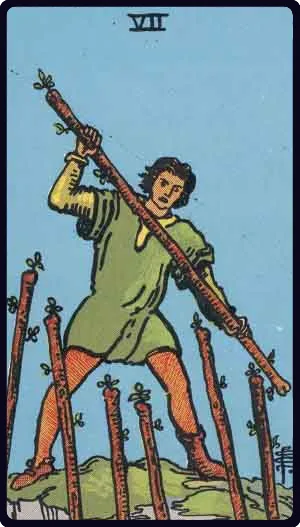
Rider–Waite–Smith
Seven of Wands — Rider–Waite–Smith
Deck-native identity is shown first.
Deck-native identity
Upright, define the position, identify the actual demand, and choose a boundary that can be maintained without treating every disagreement as a threat. If you use reversals, the primary mode is deficit: depleted capacity or weak support may make a necessary boundary difficult to hold. The only material alternative is excess, when vigilance or combativeness expands beyond the observed demand.
Limit: This is a modern Venus synthesis based on the current canonical RWS-oriented reference page, not an ancient or universal doctrine. No individual visual cue is asserted in this brief; the local asset identity is known, while exact derivative provenance and rights remain unknown.
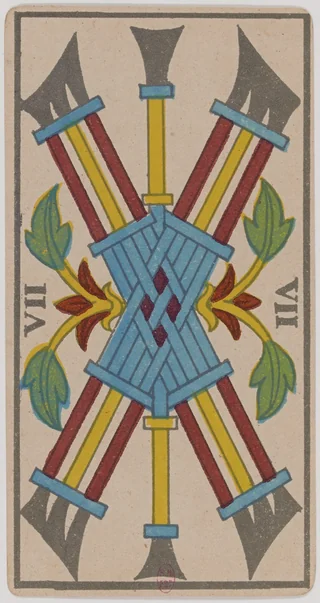
Lequart Besançon
Sept de Bâtons — Lequart Besançon
Deck-native identity is shown first.
Rank-and-suit correspondence
Sept de Bâtons can emphasize testing autonomy, resilience, and the strength of a chosen method, expressed through initiative, effort, enterprise, and direction. When excess, the same number-or-court structure can show self-protection that becomes strain, defensiveness, or isolation within initiative, effort, enterprise, and direction.
Limit: This is a modern Venus number/rank-plus-suit synthesis, not a historical doctrine attributed to the Lequart maker. Read the pip or court structure directly; do not import an absent Rider–Waite–Smith narrative scene.
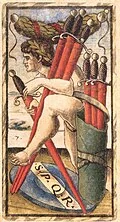
Sola Busca
Seven of Batons — Sola Busca
Deck-native identity is shown first.
Rank-and-suit correspondence
The bound cluster can emphasize consolidating effort and protecting capacity during a demanding passage. Protection can become overburdened defensiveness or refusal to set down work that no longer belongs together.
Limit: This is a modern Venus image-led synthesis, not a historical Sola Busca divinatory doctrine. Do not import an absent Rider–Waite–Smith scene; the observed local image and rank/suit structure control the reflection.
Card identities, numbering, image mappings, and semantic claims have been checked against the cited sources and reviewed evidence. Each meaning is a modern reflective interpretation—not historical doctrine, a prediction, or proof of an outcome.
How to read Seven of Wands in a real spread
Use this as a contextual reference, not as proof that the card selected itself or that a conflict exists. No personal question, orientation method, spread position, surrounding cards, or circumstances are supplied. Seven of Wands does not establish or guarantee attack, persecution, rivalry, competition, defensiveness as character, victory, successful resistance, or literal danger.
Core layer
A boundary may need to be held, but only observed pressure—not anticipated threat—can show what response is proportionate.
Reading angle
Define your position, identify the actual demand, and choose a boundary you can maintain without treating every disagreement as danger.
Reality check
The card cannot select itself, supply a spread position, prove a future event, diagnosis, private state, motive, or intent, or replace direct evidence, consent, communication, emergency action, or qualified medical, veterinary, legal, financial, mental-health, or safety help.
Seven of Wands upright meaning
Upright, define the position, identify the actual demand, and choose a boundary that can be maintained without treating every disagreement as a threat.
Seven of Wands reversed meaning
If you use reversals, the primary mode is deficit: depleted capacity or weak support may make a necessary boundary difficult to hold. The only material alternative is excess, when vigilance or combativeness expands beyond the observed demand.
Seven of Wands in love and relationships
In relationship questions, examine stated boundaries, pressure, consent, and repair. Seven of Wands cannot prove attack, rivalry, defensiveness, danger, or another person's hostile intent.
Seven of Wands in work and decisions
At work, identify the actual request, authority, stakes, deadline, support, and escalation path. The card cannot guarantee job protection, competitive success, or victory.
Seven of Wands in money and resources
For financial or business pressure, verify the demand, documents, authority, stakes, and available support. Symbolic resistance cannot guarantee a business result.
Seven of Wands as a Yes / No card
For yes/no use, Seven of Wands leans yes only for maintaining a specific, safe, evidence-based boundary with adequate capacity and support. Otherwise it is unclear, and it is not answerable for literal danger or another person's hostility.
A boundary you can hold
A conditional lean requires a specific, safe boundary plus enough evidence, capacity, and support.
Do not infer a threat
Literal danger and another person's hostility require direct assessment, not a card-based answer.
Tarot reader advice
Separate the observed demand from the anticipated threat, then choose one boundary and one source of support.
A boundary should match the pressure in front of you
A strong stance is not the same as permanent combat readiness. This card asks for enough firmness to protect a chosen position without enlarging every disagreement into a threat.
Observed demand
What has actually been asked, done, or crossed—and what part is anticipation?
Capacity
Can this boundary be maintained safely with the time, energy, authority, and support available?
Source and limits
The local Rider-Waite-Smith-named image is a project asset only. Its filename does not establish a universal tradition, historical provenance, authorship, edition, licensing, zodiac identity, image doctrine, or versioned textual source.
Practice
Write one observed demand, one proportionate boundary, and one person or resource that can support it.
Use this card in a reading
Seven of Wands is a reference point, not a personal verdict
Use this page to learn the card's supported meaning. For an applied reading, bring a specific question and let the spread position and surrounding cards supply context this reference page does not have.
The full reference meaning on this page is public. A reading adds a question, position, and context; it does not make paid access necessary to understand the card.