Six of Cups can bring memory, familiarity, or remembered care into focus. Its useful work is not to promise that the past will return, but to compare an old story with present behavior, consent, and needs.
Choose a deck to see the card identity, number, image, relation type, and modern interpretive emphasis supported for that system.
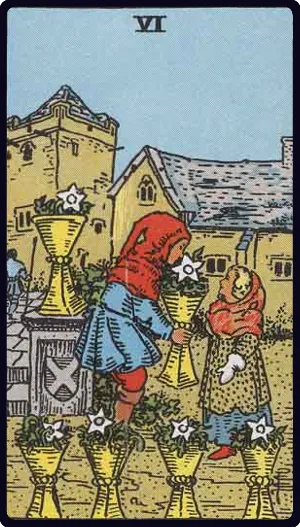
Rider–Waite–Smith
Six of Cups — Rider–Waite–Smith
Deck-native identity is shown first.
Deck-native identity
Upright, allow warmth or familiarity to be acknowledged, then compare the remembered pattern with present behavior, consent, and needs. If you use reversals, the primary mode is distorted: selective memory or idealization may be shaping the present more strongly than current evidence. The only material alternative is release, when an old emotional script can be appreciated without being repeated.
Limit: This is a modern Venus synthesis based on the current canonical RWS-oriented reference page, not an ancient or universal doctrine. No individual visual cue is asserted in this brief; the local asset identity is known, while exact derivative provenance and rights remain unknown.
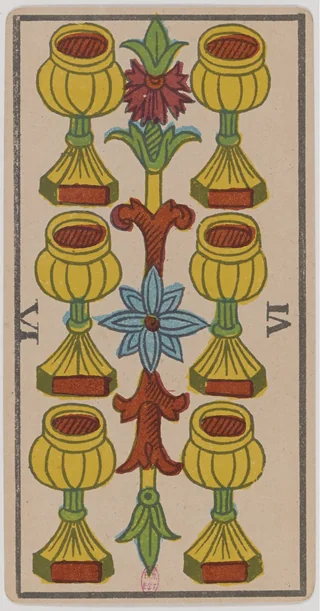
Lequart Besançon
Six de Coupes — Lequart Besançon
Deck-native identity is shown first.
Rank-and-suit correspondence
Six de Coupes can emphasize adjusting separate parts into a more workable exchange, expressed through receptivity, relationship, care, and emotional circulation. When blocked, the same number-or-court structure can show exchange that stalls because proportion or reciprocity is unclear within receptivity, relationship, care, and emotional circulation.
Limit: This is a modern Venus number/rank-plus-suit synthesis, not a historical doctrine attributed to the Lequart maker. Read the pip or court structure directly; do not import an absent Rider–Waite–Smith narrative scene.
Sola Busca
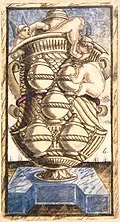
Six of Cups — Sola Busca
Deck-native identity is shown first.
Rank-and-suit correspondence
The entangled structure can emphasize closeness created through mutual support, shared history, and complex dependency. Support can become enmeshment when roles, consent, and individual capacity are difficult to distinguish.
Limit: This is a modern Venus image-led synthesis, not a historical Sola Busca divinatory doctrine. Do not import an absent Rider–Waite–Smith scene; the observed local image and rank/suit structure control the reflection.
Card identities, numbering, image mappings, and semantic claims have been checked against the cited sources and reviewed evidence. Each meaning is a modern reflective interpretation—not historical doctrine, a prediction, or proof of an outcome.
How to read Six of Cups in a real spread
This page offers a contextual reference; it does not select the card or supply a personal question, orientation method, spread position, surrounding cards, or circumstances. Six of Cups does not establish or guarantee a past person's return, reunion, childhood facts, innocence, pregnancy or children, nostalgia shared by another person, reconciliation, or soulmate history.
Core layer
Memory, familiarity, and remembered care may influence the present, but an old story needs current evidence before it is repeated.
Reading angle
Keep three things separate: what you remember, what is happening now, and what you want to happen.
Reality check
The card cannot select itself, supply a spread position, prove a future event, diagnosis, private state, motive, or intent, or replace direct evidence, consent, communication, emergency action, or qualified medical, veterinary, legal, financial, mental-health, or safety help.
Six of Cups upright meaning
Upright, allow warmth or familiarity to be acknowledged, then compare the remembered pattern with present behavior, consent, and needs.
Six of Cups reversed meaning
If you use reversals, the primary mode is distorted: selective memory or idealization may be shaping the present more strongly than current evidence. The only material alternative is release, when an old emotional script can be appreciated without being repeated.
Six of Cups in love and relationships
In relationship questions, distinguish personal memory from mutual present behavior. Six of Cups cannot prove a return, reunion, reconciliation, soulmate history, or another person's nostalgia or feelings.
Six of Cups in work and decisions
At work, notice familiar habits and prior examples, then check whether today's role, expectations, and evidence actually match the memory.
Six of Cups in money and resources
For money questions, watch for emotional spending or reliance on an old pattern. Current budgets, records, terms, and professional advice—not familiarity—should guide the decision.
Six of Cups as a Yes / No card
For yes/no use, the answer is unclear until the question is grounded in current behavior, mutual consent, and present-day feasibility. Memory or warmth alone cannot support yes.
What could clarify it
Look for present behavior, mutual consent, and a workable option in today's circumstances.
What does not count
A vivid memory, familiar feeling, or hoped-for reunion is not evidence for yes.
Tarot reader advice
Make three columns: what you remember, what is observable now, and what you want. Do not treat the first column as evidence for the other two.
Familiarity can feel persuasive because it arrives with an emotional history. The card's practical value is the pause between remembering a pattern and deciding whether it still belongs in your life.
Memory
What part of this response comes from your own recollection rather than current mutual behavior?
Present evidence
What is observable now, and has the old pattern actually changed?
Source and limits
The local Rider-Waite-Smith-named image is a project asset only. Its filename does not establish a universal tradition, historical provenance, authorship, edition, licensing, zodiac identity, image doctrine, or versioned textual source.
Practice
Place memory, present observation, and desire in separate columns before you interpret the situation.
Use this card in a reading
Six of Cups is a reference point, not a personal verdict
Use this page to learn the card's supported meaning. For an applied reading, bring a specific question and let the spread position and surrounding cards supply context this reference page does not have.
The full reference meaning on this page is public. A reading adds a question, position, and context; it does not make paid access necessary to understand the card.