Six of Swords can foreground a deliberate transition away from a draining pattern. Its value lies in planning, support, and harm reduction—not in promising travel, escape, recovery, or a safe destination.
Choose a deck to see the card identity, number, image, relation type, and modern interpretive emphasis supported for that system.
Rider–Waite–Smith
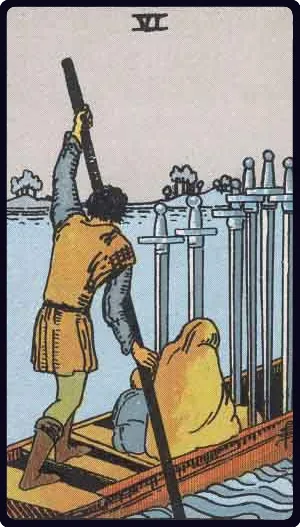
Six of Swords — Rider–Waite–Smith
Deck-native identity is shown first.
Deck-native identity
Upright, identify the condition being left, the criteria for a better situation, and the support or contingency needed to make a transition viable. If you use reversals, the primary mode is blocked: unresolved conditions, missing support, or incomplete planning may keep a transition from becoming workable. No material alternative is approved.
Limit: This is a modern Venus synthesis based on the current canonical RWS-oriented reference page, not an ancient or universal doctrine. No individual visual cue is asserted in this brief; the local asset identity is known, while exact derivative provenance and rights remain unknown.
Lequart Besançon
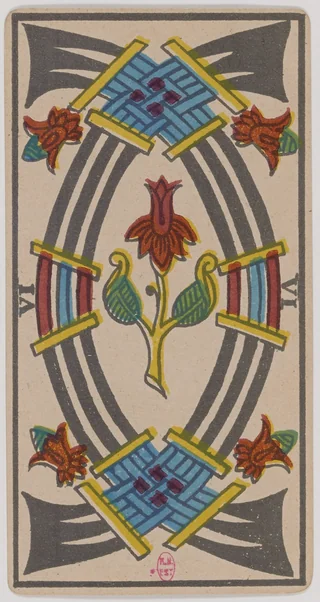
Six de Épées — Lequart Besançon
Deck-native identity is shown first.
Rank-and-suit correspondence
Six de Épées can emphasize adjusting separate parts into a more workable exchange, expressed through discernment, conflict, decisions, and consequences. When blocked, the same number-or-court structure can show exchange that stalls because proportion or reciprocity is unclear within discernment, conflict, decisions, and consequences.
Limit: This is a modern Venus number/rank-plus-suit synthesis, not a historical doctrine attributed to the Lequart maker. Read the pip or court structure directly; do not import an absent Rider–Waite–Smith narrative scene.
Sola Busca
Six of Swords — Sola Busca
Deck-native identity is shown first.
Rank-and-suit correspondence
The scene can emphasize difficult transition guided by limited but sufficient orientation. Transition can stall when the burden is not reorganized or the available light is dismissed as inadequate.
Limit: This is a modern Venus image-led synthesis, not a historical Sola Busca divinatory doctrine. Do not import an absent Rider–Waite–Smith scene; the observed local image and rank/suit structure control the reflection.
Card identities, numbering, image mappings, and semantic claims have been checked against the cited sources and reviewed evidence. Each meaning is a modern reflective interpretation—not historical doctrine, a prediction, or proof of an outcome.
How to read Six of Swords in a real spread
This is a contextual card reference, not a selected card or forecast. No personal question, orientation method, spread position, surrounding cards, or circumstances are supplied. Six of Swords does not establish or guarantee travel, relocation, moving away, escape, recovery, the end of conflict, a safer destination, or another person's departure.
Core layer
A transition may reduce strain, but only planning, support, and realistic contingencies can make it workable.
Reading angle
Name the current strain, define the minimum improvement you need, and check what support exists before changing course.
Reality check
The card cannot select itself, supply a spread position, prove a future event, diagnosis, private state, motive, or intent, or replace direct evidence, consent, communication, emergency action, or qualified medical, veterinary, legal, financial, mental-health, or safety help.
Six of Swords upright meaning
Upright, identify the condition being left, the criteria for a better situation, and the support or contingency needed to make a transition viable.
Six of Swords reversed meaning
If you use reversals, the primary mode is blocked: unresolved conditions, missing support, or incomplete planning may keep a transition from becoming workable. No material alternative is approved.
Six of Swords in love and relationships
In relationship questions, examine whether communication, distance, boundaries, or a change in pattern could reduce harm. The card cannot predict departure, reconciliation, recovery, or another person's decision.
Six of Swords in work and decisions
For work decisions, treat transition as a planning prompt. Verify contracts, timelines, alternatives, and the support available before making a move.
Six of Swords in money and resources
For money questions, calculate costs and contingencies and use qualified advice. Six of Swords cannot predict a move or an improved financial outcome.
Six of Swords as a Yes / No card
For yes/no use, Six of Swords leans yes only for a reader-controlled transition with verified destination criteria, support, costs, and contingency planning. Otherwise it is unclear, and it is not answerable for another person's departure or a guaranteed safe outcome.
A plan you control
A conditional lean requires a defined destination, support, costs, and a backup plan.
Outside the card's reach
It cannot answer whether someone else will leave or guarantee that a destination will be safe.
Tarot reader advice
Write the current strain, the minimum criteria for improvement, the support available, and one contingency before deciding whether to change course.
Distance from a draining pattern may sound like relief, but relief is not yet a plan. This reading asks what would make change safer, more supported, and realistically sustainable.
Define better
What must be measurably different for the transition to reduce harm?
Check support
Which practical support and contingency would still be available if the first plan failed?
Source and limits
The local Rider-Waite-Smith-named image is a project asset only. Its filename does not establish a universal tradition, historical provenance, authorship, edition, licensing, zodiac identity, image doctrine, or versioned textual source.
Practice
Write the strain, improvement criteria, support, and contingency on one page before choosing a route.
Use this card in a reading
Six of Swords is a reference point, not a personal verdict
Use this page to learn the card's supported meaning. For an applied reading, bring a specific question and let the spread position and surrounding cards supply context this reference page does not have.
The full reference meaning on this page is public. A reading adds a question, position, and context; it does not make paid access necessary to understand the card.