Temperance is an integration-and-pacing pattern. It asks what measured adjustment could reduce an extreme without pretending every need can be combined or every conflict should be smoothed over. This Major Arcana card does not prove medical recovery, sobriety, reconciliation, pregnancy, chemical balance, spiritual protection, or harmony.
Choose a deck to see the card identity, number, image, relation type, and modern interpretive emphasis supported for that system.
Rider–Waite–Smith
Temperance — Rider–Waite–Smith
Deck-native identity is shown first.
Deck-native identity
If upright cards are part of the method, Temperance may foreground moderation, pacing, integration, and gradual symbolic repair. Symbolic repair is not medical healing, sobriety, reconciliation, pregnancy, or proof that a harmonious outcome will occur. Reversals are optional and method-dependent. The main reversed mode is distortion: balance becomes forced compromise, suppression of a real conflict, or mixing needs that cannot safely be combined. A material alternative is deficit: pacing or integration is insufficient and one extreme is dominating.
Limit: This is a modern Venus synthesis based on the current canonical RWS-oriented reference page, not an ancient or universal doctrine. No individual visual cue is asserted in this brief; the local asset identity is known, while exact derivative provenance and rights remain unknown.
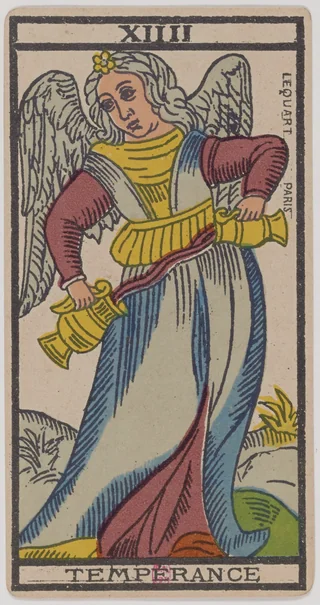
Lequart Besançon
Tempérance XIIII — Lequart Besançon
Native identity: Tempérance.
Deck-native identity
Tempérance XIIII can emphasize patient transfer, adjustment, and creating a workable mixture through repeated small corrections. Integration can stall through haste, poor proportion, or refusal to let incompatible elements remain distinct.
Limit: Balance is an active process, not a promise that every conflict can be harmonized. This is a modern Venus synthesis informed by the observed Lequart/Besançon image; it is not presented as historical Marseille doctrine.
Sola Busca
Bocho XIIII — Sola Busca
Native identity: Bocho.
Ordinal comparison only
Bocho can emphasize unstable loyalty and the need to make terms, incentives, and divided allegiances visible before attempting cooperation. Compromise can become opportunism, betrayal, or alliance without a trustworthy shared condition.
Limit: Brera associates Bocho XIIII with the Traitor; it must not be called the Sola Busca Temperance. This is a modern Venus image-led reflection, not an original Sola Busca divinatory doctrine or a historical certainty.
Card identities, numbering, image mappings, and semantic claims have been checked against the cited sources and reviewed evidence. Each meaning is a modern reflective interpretation—not historical doctrine, a prediction, or proof of an outcome.
Balance is a process, not a promised outcome
This static reference does not draw Temperance for you or establish that a situation can be reconciled. The exact question, spread position, neighboring cards, real constraints, and available choices determine whether pacing and integration are useful—or whether compromise would hide a conflict.
Adjustment
What small change could reduce an extreme without suppressing a legitimate need?
Evidence
What observable result would show that the new pace or combination is actually helping?
Reality check
Tarot cannot assess health, sobriety, pregnancy, chemical balance, or recovery and cannot replace medical, veterinary, mental-health, substance-use, legal, financial, or emergency support.
Temperance upright: measured integration
If upright cards are part of the method, Temperance may foreground moderation, pacing, integration, and gradual symbolic repair. Symbolic repair is not medical healing, sobriety, reconciliation, pregnancy, or proof that a harmonious outcome will occur.
Temperance reversed: forced compromise or an unchecked extreme
Reversals are optional and method-dependent. The main reversed mode is distortion: balance becomes forced compromise, suppression of a real conflict, or mixing needs that cannot safely be combined. A material alternative is deficit: pacing or integration is insufficient and one extreme is dominating.
Temperance in love: compromise cannot manufacture agreement
The card can prompt discussion of pacing, shared adjustments, and whether both people’s needs remain visible. It cannot prove another person’s feelings or predict reconciliation. Consent, direct communication, and observable follow-through determine whether integration is real.
Temperance at work: change one variable at a time
A measured adjustment to timing, workload, role, or process may reduce an extreme and make its effect easier to check. The card does not guarantee cooperation, promotion, recovery from burnout, or a business result.
Temperance with money: test the adjustment against the budget
This is not a price, return, or financial-recovery prediction. Use a budget, documents, deadlines, and qualified advice to see whether a moderate change actually improves the situation. Symbolic balance is not evidence of financial stability.
Temperance does not promise that things will work out
The card has no permanent yes or no. Any direction must depend on the question, position, measurable adjustment, timing, consent, missing facts, and a real-world check. If the needs cannot safely be combined, the answer may be unclear or not answerable.
What may support an adjustment
The change is specific, proportionate, consensual, and its effect can be observed.
What blocks confidence
Compromise is suppressing a real conflict, or harmony is being assumed without evidence.
Make the next adjustment measurable
Choose one measured adjustment, define the extreme it reduces, and verify whether the change is actually helping. Then read the result through the exact question and card position.
Temperance becomes practical when a small adjustment reduces an extreme and its effect can be checked. It loses value when “balance” is used to hide incompatibility, suppress conflict, or imply medical or spiritual certainty.
Extreme
What is dominating the situation now?
Adjustment
What is the smallest change likely to reduce that pressure?
Conflict
Which need must remain visible instead of being blended away?
Measure
What evidence will show whether the new balance is workable?
Put the adjustment in context
Use Temperance to test a measured change, not predict healing
A question and spread position can clarify pacing, integration, forced compromise, or an unchecked extreme without promising recovery or reconciliation.
This free reference cannot establish health, sobriety, pregnancy, or reconciliation. Applied meaning still needs context and measurable real-world evidence.