Ten of Cups can foreground a vision of shared belonging. The meaningful test is whether consent, reciprocity, repair, and ordinary daily behavior support that vision—not whether the card promises marriage, family harmony, children, or a happy ending.
Choose a deck to see the card identity, number, image, relation type, and modern interpretive emphasis supported for that system.
Rider–Waite–Smith
Ten of Cups — Rider–Waite–Smith
Deck-native identity is shown first.
Deck-native identity
Upright, name the form of belonging being valued and identify the repeated behaviors and agreements that make it livable. Treat the shared ideal as something to test and maintain, not as an outcome that is assured. Reversals are optional and method-dependent. The primary reversed mode is deficit: the shared ideal may not yet be matched by coordination, reciprocity, or emotional safety. The one material alternative is excess—pressure to appear harmonious may suppress real differences.
Limit: This is a modern Venus synthesis based on the current canonical RWS-oriented reference page, not an ancient or universal doctrine. No individual visual cue is asserted in this brief; the local asset identity is known, while exact derivative provenance and rights remain unknown.
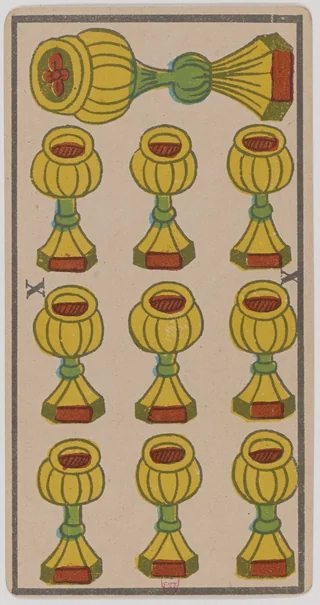
Lequart Besançon
Dix de Coupes — Lequart Besançon
Deck-native identity is shown first.
Rank-and-suit correspondence
Dix de Coupes can emphasize bringing a cycle to completion while preparing redistribution or transition, expressed through receptivity, relationship, care, and emotional circulation. When release, the same number-or-court structure can show completion that is delayed by accumulation, attachment, or unclear handoff within receptivity, relationship, care, and emotional circulation.
Limit: This is a modern Venus number/rank-plus-suit synthesis, not a historical doctrine attributed to the Lequart maker. Read the pip or court structure directly; do not import an absent Rider–Waite–Smith narrative scene.
Sola Busca
Ten of Cups — Sola Busca
Deck-native identity is shown first.
Rank-and-suit correspondence
The image can emphasize emotional culmination while asking whether the person remains visible inside the completed arrangement. A collective ideal can obscure individual needs or create pressure to perform harmony.
Limit: This is a modern Venus image-led synthesis, not a historical Sola Busca divinatory doctrine. Do not import an absent Rider–Waite–Smith scene; the observed local image and rank/suit structure control the reflection.
Card identities, numbering, image mappings, and semantic claims have been checked against the cited sources and reviewed evidence. Each meaning is a modern reflective interpretation—not historical doctrine, a prediction, or proof of an outcome.
Define what belonging means in practice
No card is selected for a person on this page, and no question, orientation method, spread position, neighboring cards, or personal circumstances are supplied. The Ten of Cups offers a contextual lens, not evidence that an ideal is shared.
Name the quality
Belonging might involve trust, welcome, repair, or shared purpose, but the relevant quality must be defined by the people involved rather than assumed from the card.
Find the daily behavior
Look for repeated actions and agreements that make the ideal livable. An appealing vision does not establish marriage, domestic happiness, children, reconciliation, or soulmate status.
Reality check
Tarot cannot establish a future event, diagnosis, private state, motive, or intent. Direct evidence, consent, communication, emergency action, and qualified medical, veterinary, legal, financial, mental-health, or safety help take priority.
Ten of Cups upright meaning
Upright, name the form of belonging being valued and identify the repeated behaviors and agreements that make it livable. Treat the shared ideal as something to test and maintain, not as a guaranteed outcome.
Ten of Cups reversed meaning
Reversals are optional and method-dependent. The primary reversed mode is deficit: the shared ideal may not yet be matched by coordination, reciprocity, or emotional safety. The one material alternative is excess—pressure to appear harmonious may suppress real differences.
Ten of Cups in love and feelings
Compare hopes for home or commitment with consent, repair, shared goals, and observable follow-through. A direct conversation matters more than the ideal. The card cannot prove marriage, children, pregnancy, reconciliation, soulmate status, or another person’s feelings.
Ten of Cups in work and decisions
Team belonging and shared values matter only alongside clear roles, performance expectations, and repeated cooperation. The card cannot guarantee approval, group harmony, or that everyone wants the same outcome.
Ten of Cups in money and resources
When resources are shared, put values beside the budget, documents, and responsibilities. Warm intentions do not create financial security or consent on behalf of other people; verify every agreement directly.
Ten of Cups as a Yes / No card
It may lean yes only when all affected people consent, goals align, and repeated behavior supports the shared vision. Otherwise, the answer remains unclear.
Evidence for yes
Consent is explicit, the goal is genuinely shared, and everyday conduct supports what people say they want.
Reason to pause
Differences are being hidden, repair is absent, or the desired harmony depends on assumptions about another person’s feelings.
Test the shared vision
Define one quality of belonging, one daily behavior that supports it, and one direct conversation needed to test whether the vision is genuinely shared.
The Rider-Waite-Smith-named image path on this page identifies a local project asset only. It does not establish image doctrine, historical provenance, authorship, edition, licensing, zodiac identity, a universal Cups correspondence, or a versioned textual source.
Core lens
A vision of shared belonging tested through consent, reciprocity, and daily behavior.
Ask next
What does emotional home mean to each person, and which repeated behavior supports it?
Hard limit
The card does not prove marriage, family harmony, children, pregnancy, reconciliation, or a happy ending.
Practice
Name the difference that needs honest discussion instead of a performance of harmony.
Test the shared vision
Apply the Ten of Cups to observable relationships
This public reference gives the complete approved meaning. A reading still needs a specific question, spread position, surrounding cards, and direct evidence of consent and follow-through.
No deeper or paid report is required to access this meaning. The people affected—not the card—define consent, belonging, and the agreements they are willing to keep. Repeating the reading does not increase certainty; pause and choose an observable action.