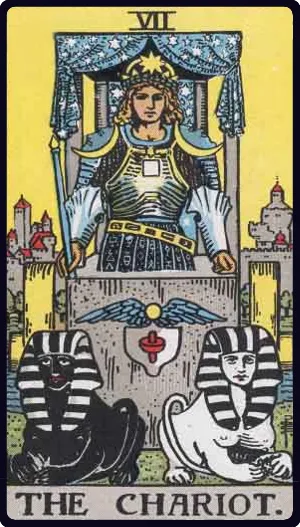
The Chariot is a direction-and-coordination pattern. It asks which aim deserves focus and how competing pressures can be steered without force. This Major Arcana card does not guarantee victory, travel, promotion, conquest, or a vehicle event.
Choose a deck to see the card identity, number, image, relation type, and modern interpretive emphasis supported for that system.
Rider–Waite–Smith
The Chariot — Rider–Waite–Smith
Deck-native identity is shown first.
Deck-native identity
If upright cards are part of the method, The Chariot may foreground chosen direction, disciplined effort, self-regulation, and coordinated movement. Movement is contextual and may be symbolic; it does not prove literal travel or guarantee victory and success. Reversals are optional and method-dependent. The main reversed mode is distortion: control becomes force, oversteering, or rigid pursuit while competing needs remain unresolved. A material alternative is blockage: momentum is limited because the aim, coordination, or conditions are not yet clear.
Limit: This is a modern Venus synthesis based on the current canonical RWS-oriented reference page, not an ancient or universal doctrine. No individual visual cue is asserted in this brief; the local asset identity is known, while exact derivative provenance and rights remain unknown.
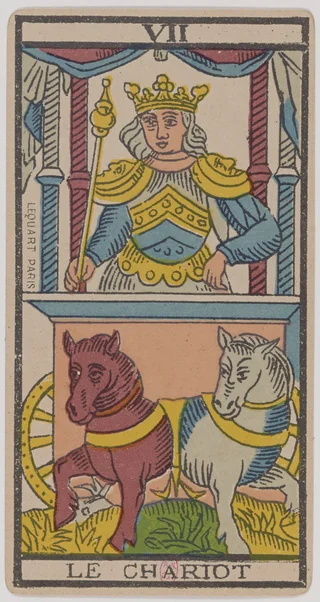
Lequart Besançon
Le Chariot VII — Lequart Besançon
Native identity: Le Chariot.
Deck-native identity
Le Chariot can emphasize directed movement that succeeds by coordinating unequal forces rather than pretending they are identical. Momentum can become control for its own sake, divided direction, or victory pursued without regard for cost.
Limit: Movement is a tendency, not a guaranteed win or journey. This is a modern Venus synthesis informed by the observed Lequart/Besançon image; it is not presented as historical Marseille doctrine.
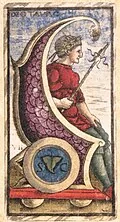
Sola Busca
Deo Tauro VII — Sola Busca
Native identity: Deo Tauro.
Ordinal comparison only
Deo Tauro can emphasize movement shaped by containment, rhythm, and the design of the vehicle rather than by raw speed. Progress can stall when the container, timing, or direction is poorly matched to what is being carried.
Limit: Do not call Deo Tauro a Chariot or infer the RWS charioteer’s doctrine. This is a modern Venus image-led reflection, not an original Sola Busca divinatory doctrine or a historical certainty.
Card identities, numbering, image mappings, and semantic claims have been checked against the cited sources and reviewed evidence. Each meaning is a modern reflective interpretation—not historical doctrine, a prediction, or proof of an outcome.
Direction matters more than raw momentum
This static reference does not draw The Chariot or predict movement for you. In an actual reading, the exact question, spread position, neighboring cards, constraints, and choices determine whether the card describes purposeful coordination or overcontrol.
Aim
Which outcome deserves priority, and what would count as useful progress toward it?
Competing pressure
Which need, responsibility, or limit is pulling in another direction and cannot simply be overpowered?
Reality check
Tarot cannot establish a medical, veterinary, legal, financial, mental-health, or safety fact, another person’s private state, or consent. Use direct evidence, communication, and qualified help when stakes require it.
The Chariot upright: coordinated movement
If upright cards are part of the method, The Chariot may foreground chosen direction, disciplined effort, self-regulation, and coordinated movement. Movement is contextual and may be symbolic; it does not prove literal travel or guarantee victory and success.
The Chariot reversed: force, oversteering, or blocked momentum
Reversals are optional and method-dependent. The main reversed mode is distortion: control becomes force, oversteering, or rigid pursuit while competing needs remain unresolved. A material alternative is blockage: momentum is limited because the aim, coordination, or conditions are not yet clear.
The Chariot in love: coordination requires two people
The card can prompt questions about direction, pacing, competing needs, and consent. It cannot prove another person’s feelings or justify steering the relationship through pressure. Look for observable cooperation and discuss the direction directly.
The Chariot at work: focus without tunnel vision
Choose the priority, clarify responsibility, and build a checkpoint for changing facts. The card does not guarantee a promotion, successful launch, victory over a competitor, or business result. Discipline remains useful only within real capacity and constraints.
The Chariot with money: momentum is not evidence
This card is not a price, profit, or travel-expense prediction. Pair any push to act with budgets, documents, deadlines, and mature risk assessment. Financial speed cannot replace verified terms or qualified advice.
The Chariot is not a guaranteed yes
Any direction must remain conditional on the question, position, capacity, timing, coordination, consent, missing facts, and a real-world check. When the aim or conditions are unclear, the answer may also be unclear or not answerable.
What may support movement
The aim is specific, competing pressures are acknowledged, and a checkpoint can catch overcontrol.
What blocks a clear answer
Speed, victory language, or force is being used to avoid unresolved constraints.
Build a checkpoint into the plan
Choose one aim, name the competing pressure, and set a checkpoint that prevents force from replacing coordination. Then return to the exact question and card position.
Self-regulation is different from control over others
The Chariot becomes useful when discipline coordinates real pressures instead of denying them. Control here is contextual self-regulation, never permission to override another person’s consent or safety.
Priority
Which aim matters most in the actual question?
Friction
What legitimate pressure is pulling against that aim?
Coordination
What plan can hold both direction and changing facts?
Checkpoint
When will you stop and test whether discipline has become force?
Put movement in context
Use The Chariot to clarify direction, not predict victory
A question and spread position can show where coordination, discipline, or a blocked aim matters. They cannot guarantee travel or success.