The Devil can frame attachment, temptation, compulsion-like pressure, compromised agency, or a bargain whose cost deserves review. It never proves a curse, possession, addiction, abuse, crime, coercive control, or another person's hidden motive.
Choose a deck to see the card identity, number, image, relation type, and modern interpretive emphasis supported for that system.
Rider–Waite–Smith
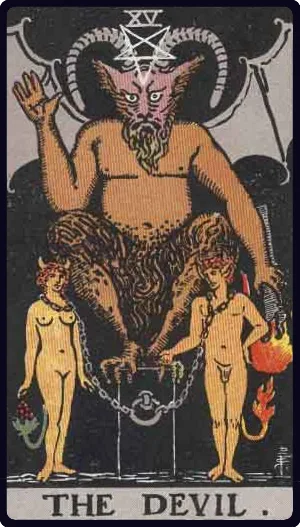
The Devil — Rider–Waite–Smith
Deck-native identity is shown first.
Deck-native identity
Upright emphasizes a more visible attachment, temptation, or pressure. That does not establish who or what controls the situation; only behavior and context can show whether a real problem exists. Reversed, the primary lens is avoidance or distortion of the attachment pattern. Emerging release is one material alternative only when observable choices show change; the card does not guarantee freedom.
Limit: This is a modern Venus synthesis based on the current canonical RWS-oriented reference page, not an ancient or universal doctrine. No individual visual cue is asserted in this brief; the local asset identity is known, while exact derivative provenance and rights remain unknown.
Lequart Besançon
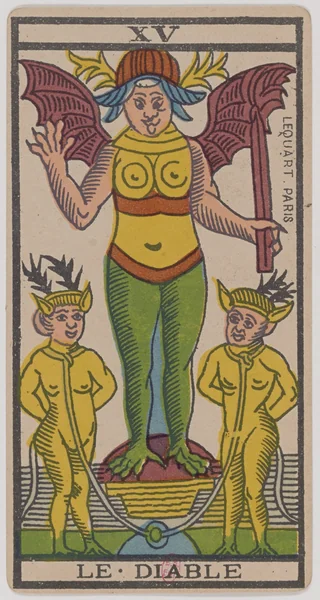
Le Diable XV — Lequart Besançon
Native identity: Le Diable.
Deck-native identity
Le Diable can emphasize attachment, appetite, and power arrangements that become clearer when their terms are named. Desire can harden into compulsion, domination, or fear-based dependence when agency and alternatives are obscured.
Limit: The card does not prove a curse, possession, abuse, addiction, or another person’s intent. This is a modern Venus synthesis informed by the observed Lequart/Besançon image; it is not presented as historical Marseille doctrine.
Sola Busca
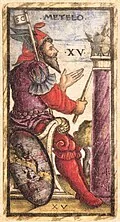
Metelo XV — Sola Busca
Native identity: Metelo.
Ordinal comparison only
Metelo can emphasize the use of authority under pressure and the need to distinguish protection from intimidation. Defensive authority can become threat, rigid command, or fear used as the main instrument of compliance.
Limit: Do not call Metelo a Devil or infer demonic influence, curse, or possession. This is a modern Venus image-led reflection, not an original Sola Busca divinatory doctrine or a historical certainty.
Card identities, numbering, image mappings, and semantic claims have been checked against the cited sources and reviewed evidence. Each meaning is a modern reflective interpretation—not historical doctrine, a prediction, or proof of an outcome.
Start with the observable cost
This unpositioned reference cannot identify a controller, cause, diagnosis, crime, or motive. Use the card only to examine a possible pattern of pressure or attachment through behavior, incentives, boundaries, and real circumstances.
Core pattern
A repeated habit, temptation, pressure, or bargain may be narrowing practical or felt agency and carrying a cost worth naming.
Position check
Obstacle can frame a binding pattern; advice can call for costs and boundaries to be named; outcome remains conditional and cannot establish abuse or control.
Reality check
If abuse, addiction, crime, coercion, or immediate danger is a real concern, assess observable facts and use appropriate professional or safety support rather than Tarot.
The Devil upright: pressure in plain view
Upright emphasizes a more visible attachment, temptation, or pressure. That does not establish who or what controls the situation; only behavior and context can show whether a real problem exists.
The Devil reversed: avoidance or distortion
Reversed, the primary lens is avoidance or distortion of the attachment pattern. Emerging release is one material alternative only when observable choices show change; the card does not guarantee freedom.
The Devil in love: name patterns, not a hidden manipulator
The card may prompt a review of attachment, pressure, incentives, or boundaries in a connection. It cannot prove another person's feelings, motives, dishonesty, abuse, or control. Consent, direct communication, consistency, and observed behavior remain the evidence.
The Devil in work: audit the bargain
Ask what incentive, obligation, habit, or boundary problem may be costing too much. Do not assign a hidden controller; compare the interpretation with actual expectations, choices, consequences, and available support.
The Devil in money: examine pressure without predicting loss
The card is not proof of financial harm or another person's intent. It may support a review of recurring costs, pressure, or a costly bargain, but budgets, documents, risk, and qualified financial guidance must direct consequential choices.
The Devil as a Yes / No card
The Devil has no permanent yes or no value. Movement is supportable only when the choice is informed, freely made, and does not repeat an observed costly pattern; reversed release requires evidence of changed behavior.
Movement is more supported when
The cost is understood, consent and agency are intact, and a realistic boundary or support step is available.
Pause is more supported when
Pressure, avoidance, missing facts, or a repeated bargain is reducing agency and has not been addressed.
Restore agency one observable step at a time
Name the habit, pressure, incentive, boundary problem, or recurring bargain you can actually observe. Then choose one boundary, action, or support step within your control. Real danger or clinical concerns belong with real-world help.
The card becomes useful when it moves attention away from frightening labels and toward what can be observed, what it costs, and what choice or support is actually available.
Observation
What habit, pressure, incentive, or boundary issue is visible?
Cost
What does the recurring bargain take in time, choice, energy, or resources?
Agency
Which choice or boundary remains within the reader's control?
Support
What real help is appropriate if the concern involves abuse, addiction, crime, coercion, or danger?
Apply the reference
The Devil needs facts, boundaries, and a real question
Use a clearly labeled reading format only if you want to examine a specific pattern. Do not use another reading to confirm fear or assign blame.
The public meaning, agency practice, and safety boundary are complete here. No deeper reading can prove a curse, possession, addiction, abuse, crime, coercive control, hidden motive, or danger.