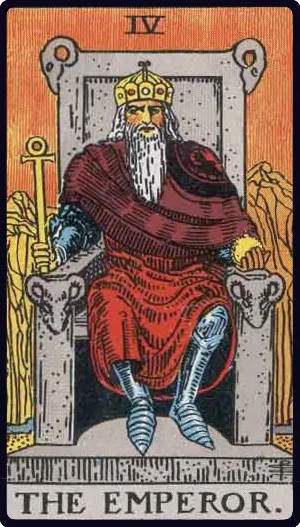
The Emperor is a structure-and-accountability pattern. It asks which rules, limits, ownership, and practical responsibilities can make action sustainable. This Major Arcana card is not proof of a father, man, boss, or guaranteed authority—and it never turns domination into sound leadership.
Choose a deck to see the card identity, number, image, relation type, and modern interpretive emphasis supported for that system.
Rider–Waite–Smith
The Emperor — Rider–Waite–Smith
Deck-native identity is shown first.
Deck-native identity
If upright cards are part of the method, The Emperor may foreground useful structure, clear limits, accountable authority, and steady execution. These are practices to evaluate, not proof that a particular person is present or that stability and success are guaranteed. Reversals are optional and method-dependent. The main reversed mode is excess: structure hardens into rigidity, control, or domination that ignores consent and changing facts. A material alternative is deficit: roles, limits, ownership, or practical structure are too weak or unclear.
Limit: This is a modern Venus synthesis based on the current canonical RWS-oriented reference page, not an ancient or universal doctrine. No individual visual cue is asserted in this brief; the local asset identity is known, while exact derivative provenance and rights remain unknown.
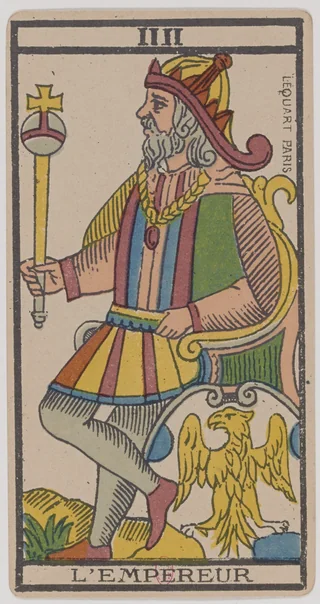
Lequart Besançon
L’Empereur IIII — Lequart Besançon
Native identity: L’Empereur.
Deck-native identity
L’Empereur can emphasize structure, enforceable limits, and responsibility for the order one creates. Structure can harden into rigidity, status defense, or rules that protect authority rather than the situation.
Limit: Authority is a role or function, not proof of a specific man. This is a modern Venus synthesis informed by the observed Lequart/Besançon image; it is not presented as historical Marseille doctrine.
Sola Busca
Mario IIII — Sola Busca
Native identity: Mario.
Ordinal comparison only
Mario can emphasize command exercised in motion, where leadership is tested by changing conditions rather than by title alone. Command can become domination, reactive force, or a refusal to revise strategy when conditions change.
Limit: Do not call Mario an Emperor or infer a specific historical person beyond the printed identity. This is a modern Venus image-led reflection, not an original Sola Busca divinatory doctrine or a historical certainty.
Card identities, numbering, image mappings, and semantic claims have been checked against the cited sources and reviewed evidence. Each meaning is a modern reflective interpretation—not historical doctrine, a prediction, or proof of an outcome.
Structure is useful only when it remains accountable
This static reference does not draw The Emperor for you or identify a person in your life. In a reading, the exact question, spread position, neighboring cards, facts, and available choices determine whether the card points toward useful structure or a problem with control.
Rule
What boundary, process, or decision standard is needed—and is it fair to the people affected?
Owner
Who is responsible for the decision, and what authority or permission do they actually have?
Reality check
Tarot cannot establish a medical, veterinary, legal, financial, mental-health, or safety fact, another person’s role or private state, or consent. Use documents, direct communication, and qualified help when stakes require it.
The Emperor upright: structure with responsibility
If upright cards are part of the method, The Emperor may foreground useful structure, clear limits, accountable authority, and steady execution. These are practices to evaluate, not proof that a particular person is present or that stability and success are guaranteed.
The Emperor reversed: too much control or too little structure
Reversals are optional and method-dependent. The main reversed mode is excess: structure hardens into rigidity, control, or domination that ignores consent and changing facts. A material alternative is deficit: roles, limits, ownership, or practical structure are too weak or unclear.
The Emperor in love: boundaries are not mind-reading
Use this card to examine agreements, responsibility, consent, and whether one person is taking too much control. It does not prove a partner’s feelings or identify a man, father figure, or dominant person. Observable conduct and direct conversation matter more than a role assigned by the card.
The Emperor at work: make authority answerable
Clarify who owns the decision, which rule applies, and how performance will be reviewed. The card cannot guarantee a promotion, leadership position, contract, legal result, or business stability. Use policies, documents, and qualified advice for those questions.
The Emperor with money: replace control with a clear system
This is not a price or outcome prediction. A budget, approval process, deadline, and record of responsibility can make the card practical. If a financial or legal decision carries real consequences, use verified documents and professional guidance.
The Emperor has no built-in yes
Structure may support action, but it does not make the outcome certain. Any direction must depend on the question, position, responsibility, authority, consent, timing, missing facts, and a real-world check; otherwise the answer may be unclear or not answerable.
What may support action
The boundary is fair, ownership is explicit, and accountability is built into the plan.
What blocks confidence
Control is replacing consent, or no one can say who owns the decision and its consequences.
Define the structure in plain terms
Define one fair boundary, who owns the decision, and how accountability will be checked. Then test that structure against the actual facts and the card’s position.
Authority is a function, not a person assigned by the card
The Emperor can clarify how decisions are contained and reviewed. It cannot identify a father, man, or boss, endorse patriarchy, or grant anyone the right to dominate.
Boundary
What limit protects the purpose without silencing consent?
Ownership
Who makes the decision and accepts its consequences?
Review
How can changing facts challenge a rule that no longer works?
Accountability
What visible check prevents authority from becoming entitlement?
Put the structure in context
Ask The Emperor what needs definition—not who controls you
A specific question and spread position can clarify boundaries, ownership, or accountability without assigning a person or promising an outcome.
This free reference remains educational. Applied meaning requires a question, spread position, context, consent, and a check against real responsibilities.