The Empress can frame care, growth, embodiment, receptivity, and the conditions that help something develop. It never proves pregnancy, fertility, motherhood, gender, body type, or any medical state.
Choose a deck to see the card identity, number, image, relation type, and modern interpretive emphasis supported for that system.
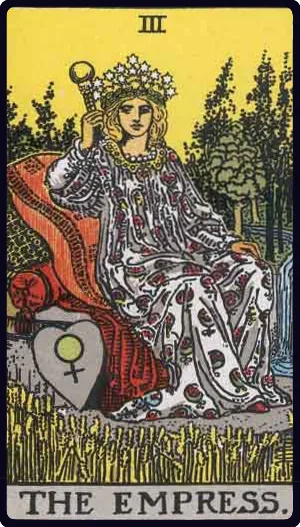
Rider–Waite–Smith
The Empress — Rider–Waite–Smith
Deck-native identity is shown first.
Deck-native identity
Upright emphasizes available care, receptivity, or developmental support. It may help identify what can be tended more consciously, but it does not establish any biological or medical state. Reversed, the primary lens is care becoming unavailable, neglected, or distorted. Overgiving or pressure is one material alternative; the reversal does not imply infertility or any reproductive condition.
Limit: This is a modern Venus synthesis based on the current canonical RWS-oriented reference page, not an ancient or universal doctrine. No individual visual cue is asserted in this brief; the local asset identity is known, while exact derivative provenance and rights remain unknown.
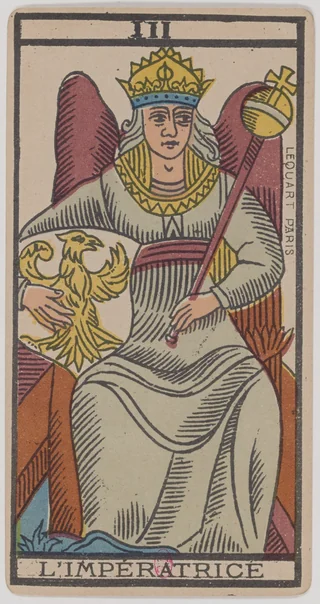
Lequart Besançon
L’Impératrice III — Lequart Besançon
Native identity: L’Impératrice.
Deck-native identity
L’Impératrice can emphasize visible stewardship: shaping conditions, protecting what is growing, and accepting responsibility for material results. Stewardship can become control, overextension, or an expectation that care must guarantee a chosen outcome.
Limit: The card does not prove fertility, pregnancy, or a specific woman. This is a modern Venus synthesis informed by the observed Lequart/Besançon image; it is not presented as historical Marseille doctrine.
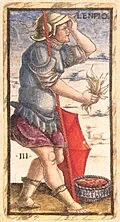
Sola Busca
Lenpio III — Sola Busca
Native identity: Lenpio.
Ordinal comparison only
Lenpio can emphasize hands-on cultivation: value develops through tending a process rather than merely possessing authority. Care can become overmanagement or constant intervention that leaves no room for the process to reveal its own condition.
Limit: Do not call Lenpio an Empress or infer fertility, pregnancy, or gender. This is a modern Venus image-led reflection, not an original Sola Busca divinatory doctrine or a historical certainty.
Card identities, numbering, image mappings, and semantic claims have been checked against the cited sources and reviewed evidence. Each meaning is a modern reflective interpretation—not historical doctrine, a prediction, or proof of an outcome.
Ask what development actually needs
This unpositioned reference cannot identify a biological state or tell you what will grow. Use it to examine whether a project, relationship, routine, or need has enough care, time, protection, resources, and balanced giving and receiving.
Core pattern
Growth may depend on nourishment, patience, receptivity, embodiment, boundaries, and the practical conditions that support development.
Position check
Advice can ask for care or a boundary; obstacle may show neglect or overgiving; outcome is only a conditional development path.
Reality check
Pregnancy, fertility, and health questions require tests and qualified medical care. Relationship questions require behavior, consent, and direct communication.
The Empress upright: care is available
Upright emphasizes available care, receptivity, or developmental support. It may help identify what can be tended more consciously, but it does not establish any biological or medical state.
The Empress reversed: care is unavailable or distorted
Reversed, the primary lens is care becoming unavailable, neglected, or distorted. Overgiving or pressure is one material alternative; the reversal does not imply infertility or any reproductive condition.
The Empress in love: assess care through behavior
The card may help you ask whether care, receptivity, boundaries, and mutual support are present. It cannot prove another person's feelings or a relationship outcome. Compare the theme with consent, consistency, direct conversation, and observable care.
The Empress in work: build the conditions, not the promise
Ask which resource, timeline, protection, collaboration, or boundary would help a project develop sustainably. The card does not guarantee success; use actual capacity, expectations, and feedback to judge what can grow.
The Empress in money: support needs without assuming abundance
The card is not a wealth or price prediction. It may prompt a review of material support, pacing, care, and resource balance, while budgets, documents, risk, and qualified advice remain the basis for financial decisions.
The Empress as a Yes / No card
The Empress has no permanent yes or no value. Development is more supportable only when the needed care, resources, boundaries, time, and facts are present; reversed may call for repair or rebalancing first.
Development is more supported when
There is enough care, capacity, protection, and room to receive as well as give.
Pause is more supported when
Care is absent, overextended, pressured, or being mistaken for proof that growth must occur.
Name one condition that would make growth healthier
Choose something concrete: time, resources, protection, patience, receiving help, or a clearer boundary. Let that condition guide the next step. Use tests and clinicians—not Tarot—for reproductive or health questions.
The Empress is most useful when growth stops being an abstract promise and becomes a practical question about what kind of support is available and sustainable.
Need
What actually needs care, patience, protection, or resources?
Condition
Which concrete support would make development more possible?
Balance
Is giving and receiving sustainable, or has care become neglect or overextension?
Boundary
What limit would protect healthy development without forcing an outcome?
Apply the reference
The Empress needs a real need, project, or relationship context
Use a clearly labeled reading format only if you want to examine what support a specific situation may need. The card does not identify a biological state.
The public care-and-growth meaning and medical boundary are complete here. No deeper reading can prove pregnancy, fertility, motherhood, gender, body type, or health status.