The Fool frames a threshold: something may invite a first step, but openness is useful only when it stays awake to risk, missing facts, and real conditions. This Major Arcana reference explains upright and optional reversed meanings without treating the card as permission to be reckless or as a promise that a new beginning will occur.
Choose a deck to see the card identity, number, image, relation type, and modern interpretive emphasis supported for that system.
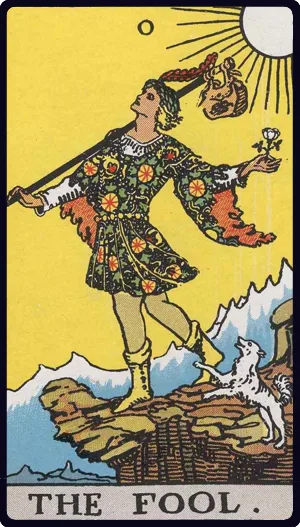
Rider–Waite–Smith
The Fool — Rider–Waite–Smith
Deck-native identity is shown first.
Deck-native identity
If a reading method uses upright cards, The Fool may foreground openness, experimentation, trust, and a consciously chosen first step. Those are possibilities to examine, not proof that action is wise, that a beginning is guaranteed, or that a specific event will happen. Reversals are optional and method-dependent, not universal opposites. The main reversed mode is distorted openness: risk becomes ungrounded, preparation is avoided, or pressure builds to leap. A material alternative is blockage: interest in beginning exists, but fear or missing facts prevent a responsible step.
Limit: This is a modern Venus synthesis based on the current canonical RWS-oriented reference page, not an ancient or universal doctrine. No individual visual cue is asserted in this brief; the local asset identity is known, while exact derivative provenance and rights remain unknown.
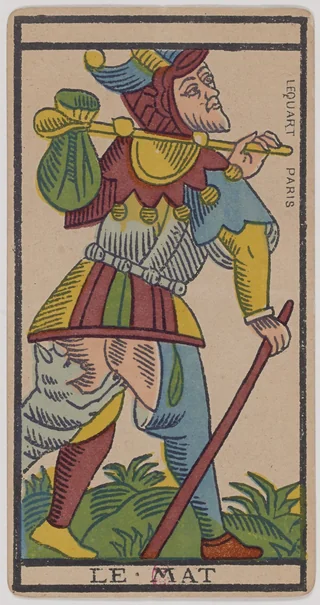
Lequart Besançon
Le Mat — Lequart Besançon
Deck-native identity is shown first.
Deck-native identity
Le Mat can emphasize motion before certainty: a step is possible, but freedom works best with attention to consequences and available support. Its open movement can become aimlessness, avoidable exposure, or refusal to recognize a practical limit.
Limit: Read the traveler and unnumbered status directly; do not reduce the card to naïveté. This is a modern Venus synthesis informed by the observed Lequart/Besançon image; it is not presented as historical Marseille doctrine.
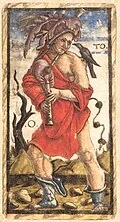
Sola Busca
Mato 0 — Sola Busca
Native identity: Mato.
Ordinal comparison only
A modern Venus reflection on Mato can emphasize stepping outside an expected role while remaining answerable for the ground actually underfoot. Nonconformity can become reflexive opposition, isolation, or risk taken mainly to preserve an identity as different.
Limit: Mato leads this record; the canonical Fool route is only ordinal comparison context. This is a modern Venus image-led reflection, not an original Sola Busca divinatory doctrine or a historical certainty.
Card identities, numbering, image mappings, and semantic claims have been checked against the cited sources and reviewed evidence. Each meaning is a modern reflective interpretation—not historical doctrine, a prediction, or proof of an outcome.
The Fool asks whether a first step is prepared
This is a static reference page, not a card draw or personalized reading. The Fool can describe a threshold pattern, but its meaning changes with the exact question, spread position, neighboring cards, circumstances, and choices.
The useful distinction
Openness makes room to learn. Impulsiveness skips the facts or safeguards needed to make a choice responsibly.
What context decides
A card in an advice position does a different job from one in an obstacle or outcome position. No position makes the card a fixed prediction.
Reality check
Tarot cannot establish a medical, veterinary, legal, financial, mental-health, or safety fact, another person’s private state, or consent. Use direct evidence, direct communication, and qualified help when stakes require it.
The Fool upright: open, but not unprepared
If a reading method uses upright cards, The Fool may foreground openness, experimentation, trust, and a consciously chosen first step. Those are possibilities to examine, not proof that action is wise, that a beginning is guaranteed, or that a specific event will happen.
The Fool reversed: when openness loses its footing
Reversals are optional and method-dependent, not universal opposites. The main reversed mode is distorted openness: risk becomes ungrounded, preparation is avoided, or pressure builds to leap. A material alternative is blockage: interest in beginning exists, but fear or missing facts prevent a responsible step.
The Fool in love: check behavior before the story
The card may help you notice openness, uncertainty, or a possible shift in how a connection is approached. It does not prove another person’s feelings, predict a new relationship, or validate risky behavior. Look at what is actually happening and confirm assumptions through direct conversation.
The Fool at work: make the experiment reversible
Use the card to ask whether a first step can be tested without pretending the outcome is known. Clarify the role, timing, permission, resources, and downside before acting; The Fool does not guarantee a job, promotion, business result, or successful launch.
The Fool with money: curiosity still needs a budget
The Fool is not a price, windfall, or investment prediction. Pair any appetite for a new direction with documents, deadlines, a mature view of risk, and qualified financial advice when needed. A symbolic invitation never replaces due diligence.
The Fool has no permanent yes or no
Any direction is conditional on the question, position, behavior, timing, responsibility, missing facts, and a real-world check. If those conditions are unavailable, the honest answer may be unclear or not answerable.
What may support a step
The action is small, reversible, fact-checked, and protected by a clear safeguard.
What prevents a clear answer
Pressure, avoidable risk, or missing information is being mistaken for courage or momentum.
A grounded way to use The Fool
Name the smallest reversible step and the fact or safeguard needed before taking it. Then check whether the actual question and spread position support that use of the card.
The Fool becomes useful when it exposes the line between learning through a manageable first step and acting before the ground is known. The card never proves that recklessness is wise, guarantees a beginning, or predicts travel, pregnancy, innocence, or any other specific event.
Notice the invitation
What feels newly possible, interesting, or worth exploring?
Find the missing ground
Which fact, skill, permission, or safeguard has not been checked?
Keep agency intact
Trust is a reflective theme here, not a command to ignore risk.
Choose the test
Take only the smallest reversible step that can produce useful information.
Use this reference with context
Give The Fool a question before giving it an answer
A spread position and a specific question can turn this reference range into a contextual prompt. They still cannot make the card prove an event or outcome.