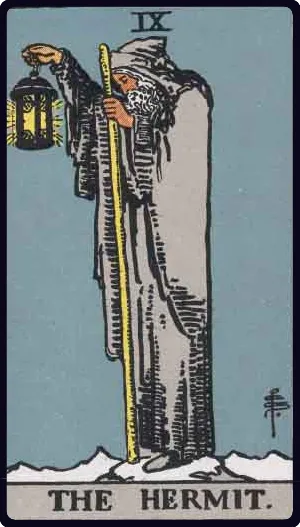
The Hermit is a reflective-distance pattern. It asks whether a chosen, bounded pause can clarify the real question without turning disconnection into a virtue. This Major Arcana card does not diagnose isolation, depression, loneliness, withdrawal, or ghosting, and it cannot explain why another person needs distance.
Choose a deck to see the card identity, number, image, relation type, and modern interpretive emphasis supported for that system.
Rider–Waite–Smith
The Hermit — Rider–Waite–Smith
Deck-native identity is shown first.
Deck-native identity
If upright cards are part of the method, The Hermit may foreground chosen solitude, reflection, quiet counsel, or a temporary pause. It does not diagnose isolation or make distance inherently wise, and it cannot tell you why someone else has withdrawn. Reversals are optional and method-dependent. The main reversed mode is excess: reflection extends into rumination or disconnection without a useful purpose or return point. A material alternative is deficit: there is too little protected space to hear one’s own question.
Limit: This is a modern Venus synthesis based on the current canonical RWS-oriented reference page, not an ancient or universal doctrine. No individual visual cue is asserted in this brief; the local asset identity is known, while exact derivative provenance and rights remain unknown.
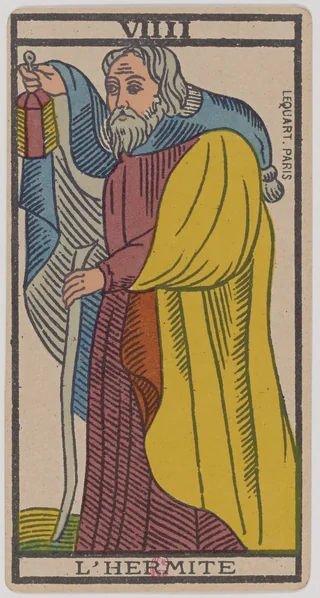
Lequart Besançon
L’Hermite VIIII — Lequart Besançon
Native identity: L’Hermite.
Deck-native identity
L’Hermite can emphasize slow examination, reduction of noise, and testing a conclusion before acting on it. Reflection can become isolation, excessive caution, or a private conclusion that is never checked against facts.
Limit: Solitude is a method, not proof that withdrawal is always wise. This is a modern Venus synthesis informed by the observed Lequart/Besançon image; it is not presented as historical Marseille doctrine.
Sola Busca
Falco VIIII — Sola Busca
Native identity: Falco.
Ordinal comparison only
Falco can emphasize lowered posture, close observation, and the wisdom of approaching a difficult task without theatrical certainty. Observation can become withdrawal or overcaution when the task requires a bounded, testable action.
Limit: Do not call Falco a Hermit or invent a lantern. This is a modern Venus image-led reflection, not an original Sola Busca divinatory doctrine or a historical certainty.
Card identities, numbering, image mappings, and semantic claims have been checked against the cited sources and reviewed evidence. Each meaning is a modern reflective interpretation—not historical doctrine, a prediction, or proof of an outcome.
A useful pause has a purpose and an end point
This static page offers a reference range; it does not draw The Hermit for you or prescribe solitude. The exact question, spread position, neighboring cards, circumstances, and choices determine whether distance creates clarity or deepens disconnection.
Purpose
What specific question should the quiet space help you examine?
Return point
When will reflection end, and what evidence, conversation, or reconnection should follow?
Reality check
Tarot cannot diagnose a mental-health condition or explain another person’s distance. When health, safety, or harmful isolation is a concern, seek real-world support instead of treating disconnection as spiritual advice.
The Hermit upright: chosen, temporary reflection
If upright cards are part of the method, The Hermit may foreground chosen solitude, reflection, quiet counsel, or a temporary pause. It does not diagnose isolation or make distance inherently wise, and it cannot tell you why someone else has withdrawn.
The Hermit reversed: too much distance or too little space
Reversals are optional and method-dependent. The main reversed mode is excess: reflection extends into rumination or disconnection without a useful purpose or return point. A material alternative is deficit: there is too little protected space to hear one’s own question.
The Hermit in love: distance does not reveal motive
The card can help you ask whether temporary space would support clearer communication. It cannot diagnose ghosting, prove another person’s feelings, or explain their silence. Look at actual contact and behavior, and communicate directly where it is safe and appropriate.
The Hermit at work: schedule reflection, then return to facts
A bounded review period may help clarify a role, decision, or next question. The card does not guarantee insight, approval, or a career outcome. Set a deadline, gather the relevant information, and decide what action follows.
The Hermit with money: a pause should improve the decision
This is not a price or investment prediction. Taking time can be useful only if it leads to better documents, budgets, risk checks, or qualified advice. Delay without a purpose is not automatically prudent.
The Hermit is not a universal no
Any direction must be conditional on the question, position, purpose of the pause, timing, responsibility, missing facts, and a real-world check. If reflection cannot produce a clearer next step, the binary may be unclear or not answerable.
What may support a pause
The space is chosen, temporary, tied to a clear question, and followed by evidence or reconnection.
What weakens the answer
Distance has no purpose or return point, or another person’s silence is being interpreted as fact.
Put a boundary around reflection
Set a purpose and time boundary for reflection, then decide what evidence, conversation, or reconnection follows. Use the card position to refine that plan, not to diagnose anyone.
The Hermit becomes practical when distance serves a named purpose and ends with a responsible return to evidence, conversation, or connection. Without that boundary, a pause can become rumination or disconnection.
Purpose
What should this quiet period help clarify?
Duration
How much time is enough before reflection turns repetitive?
Evidence
What fact or observation must be checked afterward?
Return
What conversation, decision, or reconnection follows the pause?
Give reflection a defined job
Use The Hermit to frame a pause, not explain another person
A specific question and spread position can clarify whether chosen space, excess distance, or missing reflection is relevant.