The Hierophant is a values-and-framework pattern. It asks which teachings or shared rules are useful, chosen, and still open to examination. This Major Arcana card does not require religion, marriage, obedience, formal education, institutional approval, or conformity.
Choose a deck to see the card identity, number, image, relation type, and modern interpretive emphasis supported for that system.
Rider–Waite–Smith
The Hierophant — Rider–Waite–Smith
Deck-native identity is shown first.
Deck-native identity
If upright cards are part of the method, The Hierophant may foreground learning, mentorship, shared values, or a chosen framework. It does not require institutional or religious conformity, and it does not make any teacher, rule, or tradition automatically trustworthy. Reversals are optional and method-dependent. The main reversed mode is distortion: inherited rules or belonging pressure override judgment, consent, or present needs. A material alternative is release: a convention is being reconsidered so the values that remain useful can be chosen deliberately.
Limit: This is a modern Venus synthesis based on the current canonical RWS-oriented reference page, not an ancient or universal doctrine. No individual visual cue is asserted in this brief; the local asset identity is known, while exact derivative provenance and rights remain unknown.
Lequart Besançon
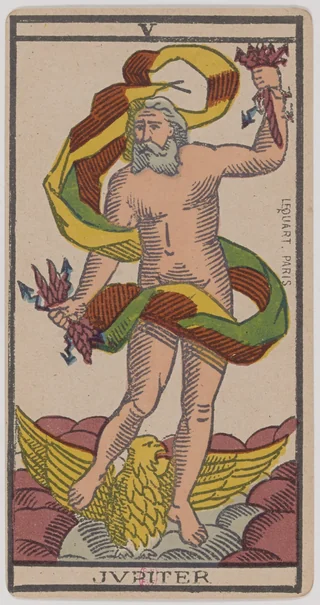
Jupiter V — Lequart Besançon
Native identity: Jupiter.
Historical variant correspondence
Jupiter V can emphasize sanction, expansive authority, and the need to align power with accountable purpose. Expansion can become overreach, borrowed authority, or confidence unsupported by real competence.
Limit: This is Jupiter in a Besançon variant, not a Pope giving ecclesiastical blessing. This is a modern Venus synthesis informed by the observed Lequart/Besançon image; it is not presented as historical Marseille doctrine.
Sola Busca
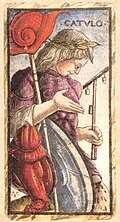
Catulo V — Sola Busca
Native identity: Catulo.
Ordinal comparison only
Catulo can emphasize learning authority through direct practice, posture, and responsibility for the tool one carries. Potential authority can remain immature when form is copied without experience or accountability.
Limit: Do not call Catulo a Hierophant, priest, or moral authority without source support. This is a modern Venus image-led reflection, not an original Sola Busca divinatory doctrine or a historical certainty.
Card identities, numbering, image mappings, and semantic claims have been checked against the cited sources and reviewed evidence. Each meaning is a modern reflective interpretation—not historical doctrine, a prediction, or proof of an outcome.
A useful framework can survive honest questions
This static page offers a reference range; it does not select The Hierophant for you or issue a command. The exact question, spread position, neighboring cards, facts, and choices determine whether a teaching supports judgment or pressures someone to conform.
Source
Where did the advice, rule, or expectation come from, and what gives it credibility here?
Choice
Is the framework being followed freely, or mainly to preserve approval and belonging?
Reality check
Tarot cannot establish a medical, veterinary, legal, financial, mental-health, or safety fact, another person’s private state, or consent. Use direct evidence, direct communication, and qualified help when stakes require it.
The Hierophant upright: learning within a chosen framework
If upright cards are part of the method, The Hierophant may foreground learning, mentorship, shared values, or a chosen framework. It does not require institutional or religious conformity, and it does not make any teacher, rule, or tradition automatically trustworthy.
The Hierophant reversed: pressure to conform or a conscious release
Reversals are optional and method-dependent. The main reversed mode is distortion: inherited rules or belonging pressure override judgment, consent, or present needs. A material alternative is release: a convention is being reconsidered so the values that remain useful can be chosen deliberately.
The Hierophant in love: discuss values, not predictions
The card can prompt a conversation about shared expectations, advice, and the rules a relationship has inherited. It cannot prove another person’s feelings or predict marriage, commitment, a ceremony, or institutional approval. Consent and direct communication decide what is actually shared.
The Hierophant at work: ask who wrote the rule
Policies, mentors, training, and shared standards may be relevant, but the card does not guarantee education, certification, approval, a contract, or a career outcome. Check the actual policy, qualifications, responsibilities, and room for informed disagreement.
The Hierophant with money: conventions still need evidence
This is not a price or contract prediction. Financial rules and professional guidance can be useful when their source, incentives, documents, and consequences are clear. Tarot cannot replace verified terms or qualified advice.
Tradition is not an automatic yes
The Hierophant has no permanent binary value. Any direction must depend on the question, position, chosen values, consent, timing, responsibility, missing facts, and a real-world check. Institutional approval cannot be inferred from the card.
What may support a choice
The framework is understood, freely chosen, relevant to the present facts, and open to review.
What makes the answer unclear
Belonging pressure or inherited habit is being mistaken for informed agreement.
Audit the rule before following it
Name the rule or advice being followed, its source, and whether it still serves the situation by choice. Then consider the card’s actual position and the evidence available.
Belonging and judgment can pull in different directions
The Hierophant becomes useful when it shows where shared knowledge supports a choice and where approval pressure has started to replace one. Tradition is contextual here, not a specific religion, school, ritual, or command.
Teaching
What has this framework helped you understand or practice?
Pressure
What might be lost by questioning the group’s expectation?
Consent
Can this rule be chosen freely and reconsidered safely?
Present value
Which principle still serves the current situation on its merits?
Give the framework a real question
Use The Hierophant to examine guidance, not obey it blindly
A spread position can clarify whether the card concerns teaching, shared values, conformity pressure, or release from a convention.