The High Priestess is an observation-and-discernment pattern. It asks you to pause, notice an inner signal, and separate intuition from anxiety, projection, or assumption. This Major Arcana reference does not certify psychic knowledge, expose a secret, or prove another person’s concealed motive.
Choose a deck to see the card identity, number, image, relation type, and modern interpretive emphasis supported for that system.
Rider–Waite–Smith
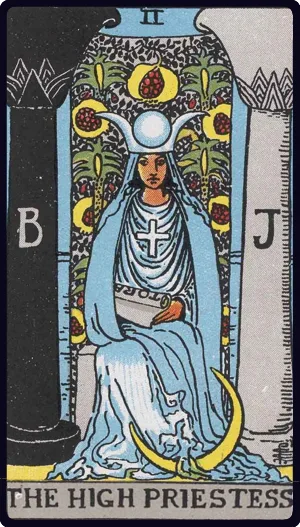
The High Priestess — Rider–Waite–Smith
Deck-native identity is shown first.
Deck-native identity
If the chosen method uses upright cards, The High Priestess may foreground receptivity, observation, silence, and waiting for adequate information. It does not certify intuition as fact or prove psychic access, secrecy, infidelity, pregnancy, or any hidden event. Reversals are optional and method-dependent. The main reversed mode is distortion: silence or inward attention becomes avoidance, projection, or unsupported certainty. A material alternative is blockage: a tentative inner response is hard to hear or trust, so observable checks are needed.
Limit: This is a modern Venus synthesis based on the current canonical RWS-oriented reference page, not an ancient or universal doctrine. No individual visual cue is asserted in this brief; the local asset identity is known, while exact derivative provenance and rights remain unknown.
Lequart Besançon
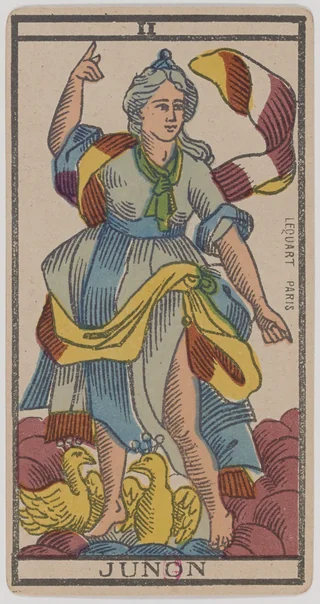
Junon II — Lequart Besançon
Native identity: Junon.
Historical variant correspondence
Junon II can emphasize sovereign discernment, the coordination of competing obligations, and authority that does not need to imitate another role. Authority may remain performative or divided when judgment is held inward but never translated into a clear boundary.
Limit: This is Junon in a Besançon variant, not a Papess holding a secret book. This is a modern Venus synthesis informed by the observed Lequart/Besançon image; it is not presented as historical Marseille doctrine.
Sola Busca
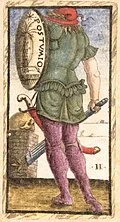
Postumio II — Sola Busca
Native identity: Postumio.
Ordinal comparison only
Postumio can emphasize guarded attention, strategic reserve, and examining what is not visible from the current stance. Reserve can become concealment, disengagement, or reliance on private assumptions that have not been tested.
Limit: Do not call Postumio a High Priestess or invent a book, veil, or feminine identity. This is a modern Venus image-led reflection, not an original Sola Busca divinatory doctrine or a historical certainty.
Card identities, numbering, image mappings, and semantic claims have been checked against the cited sources and reviewed evidence. Each meaning is a modern reflective interpretation—not historical doctrine, a prediction, or proof of an outcome.
The High Priestess begins with what is not yet known
This is a static reference page, not a selected card or personalized reading. The High Priestess may highlight inward attention or incomplete information, but the exact question, spread position, neighboring cards, circumstances, and evidence decide how useful that lens is.
Inner signal
Notice the impression without promoting it to a fact. Intuition can begin an inquiry; it cannot finish one by itself.
Alternative explanation
Ask what else could account for the same feeling, silence, or incomplete information.
Reality check
Tarot cannot establish a medical, veterinary, legal, financial, mental-health, or safety fact, pregnancy, another person’s private state, or consent. Use direct evidence, communication, and qualified help when stakes require it.
The High Priestess upright: receptive, not certain
If the chosen method uses upright cards, The High Priestess may foreground receptivity, observation, silence, and waiting for adequate information. It does not certify intuition as fact or prove psychic access, secrecy, infidelity, pregnancy, or any hidden event.
The High Priestess reversed: when inward attention distorts
Reversals are optional and method-dependent. The main reversed mode is distortion: silence or inward attention becomes avoidance, projection, or unsupported certainty. A material alternative is blockage: a tentative inner response is hard to hear or trust, so observable checks are needed.
The High Priestess in love: silence is not evidence
The card may help identify uncertainty, a need to observe, or an assumption that has not been tested. It cannot prove secret feelings, infidelity, honesty, or another person’s motive. Check visible behavior and ask directly where communication is safe and appropriate.
The High Priestess at work: identify the missing information
Before acting, separate what is documented from what is sensed or inferred. Clarify roles, timing, facts, and decision boundaries. The card does not guarantee an offer, approval, career outcome, or unseen support.
The High Priestess with money: verify what the numbers do not show
This card is not a price or investment prediction. Use it to notice an information gap, then check budgets, documents, deadlines, and professional advice. An uneasy feeling can prompt due diligence; it cannot replace it.
Silence does not equal yes or no
The High Priestess has no permanent binary value. Any direction must be conditional on the exact question, spread position, behavior, timing, responsibility, missing facts, and a real-world check. If the needed information is unavailable, the answer may be unclear or not answerable.
What may support waiting
A short pause has a purpose and a clear way to gather the missing information.
What prevents certainty
An impression, silence, or emotional tone is being treated as proof of a private fact.
Put intuition into a form you can test
Write the intuition as a hypothesis, list an alternative explanation, and identify what can be confirmed directly. Then return to the actual question and card position.
The High Priestess is most useful when inward attention remains open to correction. The work is not to prove that you know what is hidden; it is to distinguish a tentative signal from the story built around it.
Name the signal
What are you sensing before interpretation begins?
Name the assumption
Which conclusion has been added without direct support?
Find another explanation
What else could fit the same available facts?
Choose the check
What can be observed, documented, or asked directly?
Move from impression to context
Use The High Priestess to refine a question, not claim a secret
A spread position can show whether observation, uncertainty, or a pause is relevant. It cannot turn intuition into proof.