The Lovers can frame choice, value alignment, desire, relationship, and the responsibilities attached to a decision. It never proves a soulmate or twin-flame bond, fidelity, marriage, another person's feelings, or a guaranteed relationship outcome.
Choose a deck to see the card identity, number, image, relation type, and modern interpretive emphasis supported for that system.
Rider–Waite–Smith
The Lovers — Rider–Waite–Smith
Deck-native identity is shown first.
Deck-native identity
Upright emphasizes a more available alignment or conscious choice. It does not prove mutual feelings, fidelity, commitment, marriage, or union. Reversed, the primary lens is misalignment or avoidance of choice. Relational pressure is one material alternative; the card does not prove betrayal or breakup.
Limit: This is a modern Venus synthesis based on the current canonical RWS-oriented reference page, not an ancient or universal doctrine. No individual visual cue is asserted in this brief; the local asset identity is known, while exact derivative provenance and rights remain unknown.
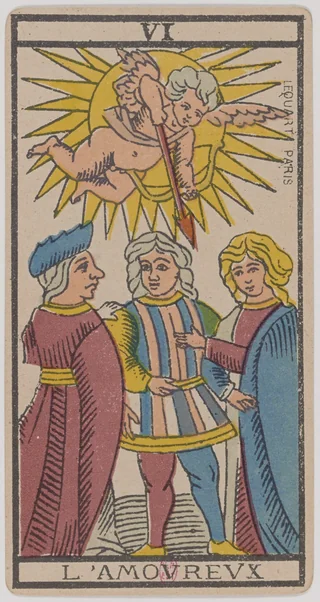
Lequart Besançon
L’Amoureux VI — Lequart Besançon
Native identity: L’Amoureux.
Deck-native identity
L’Amoureux can emphasize a consequential choice shaped by desire, social influence, and competing loyalties. Choice can stall when attraction, approval, or pressure is mistaken for consent and durable alignment.
Limit: The image does not prove mutual love, fidelity, or a destined relationship. This is a modern Venus synthesis informed by the observed Lequart/Besançon image; it is not presented as historical Marseille doctrine.
Sola Busca
Sesto VI — Sola Busca
Native identity: Sesto.
Ordinal comparison only
Sesto can emphasize disciplined readiness and the need to decide what one is prepared to stand behind in action. Readiness can become posturing, coercion, or commitment to a stance before its consequences are understood.
Limit: Sesto VI is an ordinal-only comparison and not a direct Lovers identity. This is a modern Venus image-led reflection, not an original Sola Busca divinatory doctrine or a historical certainty.
Card identities, numbering, image mappings, and semantic claims have been checked against the cited sources and reviewed evidence. Each meaning is a modern reflective interpretation—not historical doctrine, a prediction, or proof of an outcome.
Test attraction against relational reality
This unpositioned reference cannot establish mutuality or tell you what another person feels. Use it to examine the reader's choice and compare desire with consent, consistency, compatibility, values, and observable behavior.
Core pattern
A choice may carry consequences and relational responsibilities that deserve as much attention as attraction or desire.
Position check
Advice asks which value should guide action; obstacle may show misalignment; outcome is only a conditional direction, never a relationship promise.
Reality check
Direct communication, consent, boundaries, consistency, and behavior outrank Tarot inference in relationship decisions.
The Lovers upright: alignment or conscious choice is available
Upright emphasizes a more available alignment or conscious choice. It does not prove mutual feelings, fidelity, commitment, marriage, or union.
The Lovers reversed: misalignment or avoided choice
Reversed, the primary lens is misalignment or avoidance of choice. Relational pressure is one material alternative; the card does not prove betrayal or breakup.
The Lovers in love: mutuality needs evidence
The card may help clarify what the reader values and whether attraction aligns with consent, consistency, compatibility, and behavior. It cannot say “they love you,” prove fidelity, or identify a soulmate. Ask directly and respect the answer and boundaries.
The Lovers in work: choose by values and consequences
When a work decision involves competing paths, name the value that should guide the choice and the responsibility each option carries. The card does not choose for you; compare the lens with actual terms, expectations, and consequences.
The Lovers in money: alignment does not replace a budget
The card may prompt a values check around a financial choice, but it is not a price or outcome prediction. Use budgets, documents, deadlines, risk, and qualified advice to decide whether the choice is workable.
The Lovers as a Yes / No card
The Lovers has no permanent yes or no value. A direction toward connection or agreement is supportable only when mutual behavior, consent, compatible terms, and real conditions align; reversed may call for clarification or a boundary.
Movement is more supported when
The choice matches stated values and is backed by mutual consent, consistency, and observable action.
Pause is more supported when
Desire is being treated as proof, values conflict, consent is unclear, or behavior and words do not align.
Name the value and the behavior it requires
Choose the value that should guide the next step, then name one observable behavior that would demonstrate alignment. If the evidence is absent, keep the question open rather than turning attraction into certainty.
The card becomes more useful when attraction is treated as one part of a decision and not as evidence of destiny, mutuality, or durability.
Desire
What does the reader want, without assuming another person's answer?
Values
Which value should guide the choice and its consequences?
Mutuality
What consent, consistency, compatibility, and behavior are actually visible?
Boundary
What next step respects both agency and the evidence available?
Apply the reference
The Lovers needs a choice the reader can actually make
Use a clearly labeled reading format only if you want to examine a specific decision. Another reading cannot establish a bond or another person's private state.
The public choice-and-alignment meaning and consent boundary are complete here. No deeper reading can prove a soulmate bond, fidelity, marriage, feelings, betrayal, breakup, reconciliation, or outcome.