The Tower can frame disruption, truth pressure, sudden reassessment, breakthrough, or an unsustainable structure that cannot keep functioning as before. It never guarantees disaster, accident, breakup, loss, violence, punishment, or any external event.
Choose a deck to see the card identity, number, image, relation type, and modern interpretive emphasis supported for that system.
Rider–Waite–Smith
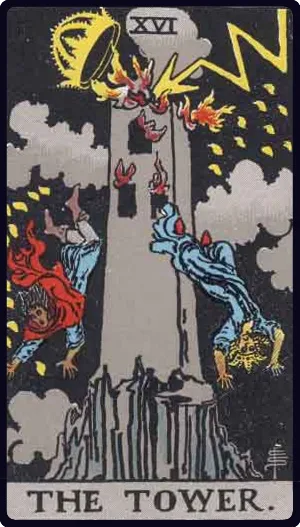
The Tower — Rider–Waite–Smith
Deck-native identity is shown first.
Deck-native identity
Upright emphasizes a more direct encounter with disruption, breakthrough, or pressure to reassess a structure. It does not predict an external disaster or prove that a hidden truth has been revealed. Reversed, the primary lens is avoidance or delay of necessary reassessment. Internalized disruption is one material alternative; the card does not mean a disaster has been prevented or guaranteed.
Limit: This is a modern Venus synthesis based on the current canonical RWS-oriented reference page, not an ancient or universal doctrine. No individual visual cue is asserted in this brief; the local asset identity is known, while exact derivative provenance and rights remain unknown.
Lequart Besançon
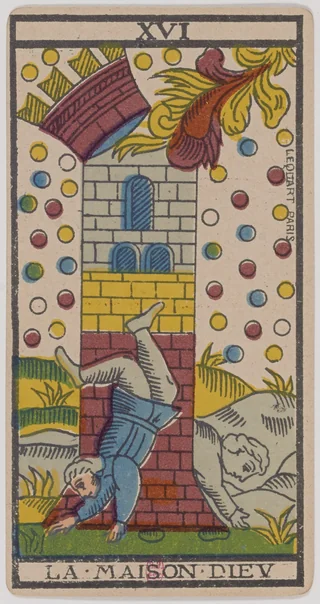
La Maison Dieu XVI — Lequart Besançon
Native identity: La Maison Dieu.
Deck-native identity
La Maison Dieu can emphasize a structure opening under pressure, revealing what its previous form could no longer contain. Necessary change can be resisted, or disruption can be intensified by acting before safety and support are assessed.
Limit: The image does not guarantee catastrophe, punishment, or sudden external ruin. This is a modern Venus synthesis informed by the observed Lequart/Besançon image; it is not presented as historical Marseille doctrine.
Sola Busca
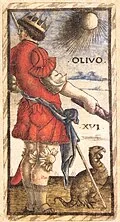
Olivo XVI — Sola Busca
Native identity: Olivo.
Ordinal comparison only
Olivo can emphasize stewardship after an irreversible cut: assess what remains, what was removed, and what responsibility follows. Loss can be denied or repeated when authority focuses on appearance instead of the condition of the living system.
Limit: Olivo XVI is an ordinal-only comparison and not a direct Tower identity. This is a modern Venus image-led reflection, not an original Sola Busca divinatory doctrine or a historical certainty.
Card identities, numbering, image mappings, and semantic claims have been checked against the cited sources and reviewed evidence. Each meaning is a modern reflective interpretation—not historical doctrine, a prediction, or proof of an outcome.
Stabilize before interpreting the disruption
This unpositioned reference cannot identify an emergency or predict an event. Begin by separating urgent facts from panic, then ask whether an assumption or structure may need calm reassessment.
Core pattern
Pressure may be exposing an unsustainable assumption, arrangement, or response that cannot keep functioning in the same way.
Position check
Obstacle may frame instability or panic; advice calls for stabilization and facts; outcome is only a conditional restructuring path.
Reality check
If there is an actual emergency, violence risk, accident, abuse, or threat, prioritize emergency or trusted real-world support rather than continuing Tarot interpretation.
The Tower upright: direct disruption or structural pressure
Upright emphasizes a more direct encounter with disruption, breakthrough, or pressure to reassess a structure. It does not predict an external disaster or prove that a hidden truth has been revealed.
The Tower reversed: avoiding or delaying reassessment
Reversed, the primary lens is avoidance or delay of necessary reassessment. Internalized disruption is one material alternative; the card does not mean a disaster has been prevented or guaranteed.
The Tower in love: reassess the structure without predicting a breakup
The card may help examine an unstable assumption, communication pattern, or relationship structure. It cannot prove feelings, a breakup, loss, violence, or punishment. Use behavior, consent, boundaries, and direct conversation to establish what needs attention.
The Tower in work: verify what is actually unstable
Ask which assumption, process, role, or expectation may no longer hold. Do not forecast collapse or job loss; check actual decisions, documentation, deadlines, dependencies, and support before choosing a response.
The Tower in money: check risk without forecasting loss
The card is not a crash, accident, or loss prediction. It may prompt a review of unstable assumptions or weak structures, while budgets, documents, risk controls, and qualified advice must guide financial action.
The Tower as a Yes / No card
The Tower has no permanent yes or no value. Movement is supportable only after urgent facts are checked and the proposed change addresses a real unstable structure; reversed may call for reassessment rather than avoidance.
Movement is more supported when
The facts identify the unstable assumption and a safe restructuring step is available.
Pause is more supported when
Panic is being treated as evidence, the risk is unverified, or avoidance is replacing a necessary review.
Check one urgent fact, then one structural assumption
Stabilize first. Verify what is happening now, identify the assumption or structure under pressure, and choose one change that can be made safely. Real danger belongs with emergency or trusted support.
The Tower becomes useful when alarm is slowed down long enough to distinguish a symbolic pressure point from an actual urgent fact.
Stabilize
What would reduce panic enough to assess the situation clearly?
Verify
What urgent fact can be checked now?
Reassess
Which assumption or structure is actually under pressure?
Respond
What one safe change or support step is within the reader's control?
Apply the reference
The Tower needs facts before another interpretation
Use a clearly labeled reading format only if the situation is stable enough for reflection. Do not use another reading to escalate panic or search for a predicted disaster.
The public disruption lens and emergency boundary are complete here. No deeper reading can guarantee disaster, accident, breakup, loss, violence, punishment, collapse, or any external event.