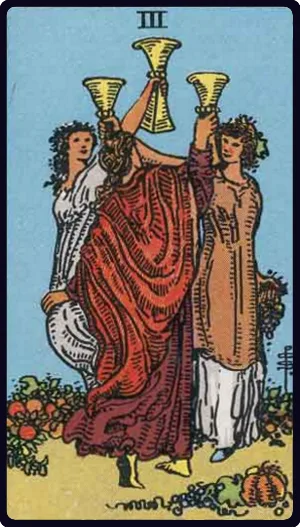
Three of Cups can focus a reading on shared support, participation, and the wider social field around an experience. The meaningful question is whether belonging is demonstrated through consent and reciprocity, not whether a celebratory idea proves a bond.
Choose a deck to see the card identity, number, image, relation type, and modern interpretive emphasis supported for that system.
Rider–Waite–Smith
Three of Cups — Rider–Waite–Smith
Deck-native identity is shown first.
Deck-native identity
Upright, Three of Cups emphasizes reciprocal participation and support shown through inclusion, consent, contribution, and reliable presence. Warmth matters here, but participation has to be real rather than assumed. If you use reversals, the primary reading is distorted: belonging may turn into approval-seeking, idealized togetherness, or social performance that hides the lack of reciprocity. A relevant alternative is excess, when group demands, socializing, or emotional involvement crowd out boundaries and individual needs.
Limit: This is a modern Venus synthesis based on the current canonical RWS-oriented reference page, not an ancient or universal doctrine. No individual visual cue is asserted in this brief; the local asset identity is known, while exact derivative provenance and rights remain unknown.
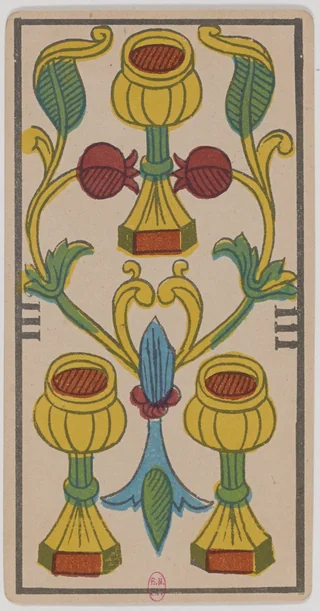
Lequart Besançon
Trois de Coupes — Lequart Besançon
Deck-native identity is shown first.
Rank-and-suit correspondence
Trois de Coupes can emphasize combining elements so a pattern can expand beyond its starting point, expressed through receptivity, relationship, care, and emotional circulation. When deficit, the same number-or-court structure can show insufficient integration, support, or shared purpose within receptivity, relationship, care, and emotional circulation.
Limit: This is a modern Venus number/rank-plus-suit synthesis, not a historical doctrine attributed to the Lequart maker. Read the pip or court structure directly; do not import an absent Rider–Waite–Smith narrative scene.
Sola Busca
Three of Cups — Sola Busca
Deck-native identity is shown first.
Rank-and-suit correspondence
The branching structure can emphasize emotional or creative growth that depends on circulation among distinct containers. Connection can become tangled or diffuse when every branch competes for the same attention.
Limit: This is a modern Venus image-led synthesis, not a historical Sola Busca divinatory doctrine. Do not import an absent Rider–Waite–Smith scene; the observed local image and rank/suit structure control the reflection.
Card identities, numbering, image mappings, and semantic claims have been checked against the cited sources and reviewed evidence. Each meaning is a modern reflective interpretation—not historical doctrine, a prediction, or proof of an outcome.
How to read Three of Cups in a real spread
Treat this page as a contextual reference, not a personal verdict. The question, orientation method, spread position, neighboring cards, consent, and real circumstances determine how the theme applies.
Core layer
The card may foreground shared support, participation, mutual acknowledgment, and the people or group context surrounding an experience.
Reading angle
Look for inclusion that is visible: who agreed to participate, who contributes, whether expectations are shared, and whether individual boundaries still have room.
Reality check
The card cannot select itself, supply a spread position, prove a future event or private state, or replace direct evidence, consent, communication, emergency action, or qualified health, veterinary, legal, financial, mental-health, or safety help.
Three of Cups upright meaning
Upright, Three of Cups emphasizes reciprocal participation and support shown through inclusion, consent, contribution, and reliable presence. Warmth matters here, but participation has to be real rather than assumed.
Three of Cups reversed meaning
If you use reversals, the primary reading is distorted: belonging may turn into approval-seeking, idealized togetherness, or social performance that hides the lack of reciprocity. A relevant alternative is excess, when group demands, socializing, or emotional involvement crowd out boundaries and individual needs.
Three of Cups in love and feelings
In relationship questions, examine the observable social context, inclusion, reciprocity, and boundaries. Three of Cups cannot identify a third party, prove reconciliation, or establish anyone's feelings, friendship, or loyalty.
Three of Cups in work and decisions
At work, the card can help review participation: who is present, what each person contributes, and whether support is reliable. It does not guarantee team loyalty, friendship, successful collaboration, or a celebratory result.
Three of Cups in money and resources
For money or shared-resource questions, confirm the arrangement, contribution, consent, and logistics directly. Budgets, documents, and qualified advice matter more than a symbolic sense of goodwill.
Three of Cups as a Yes / No card
Three of Cups can lean yes only for a participation or support question when consent, reciprocity, and logistics are visible. If group dynamics or loyalty are unverified, the answer remains unclear.
Leans yes when
Everyone involved has agreed, participation is reciprocal, and the practical details are workable.
Stays unclear when
Belonging is assumed, group pressure replaces consent, or loyalty has not been demonstrated.
Tarot reader advice
Identify one act of mutual support, confirm consent and expectations directly, and notice whether participation is reciprocal rather than assumed. A simple agreement is more useful than a hopeful group story.
Belonging can feel obvious before its terms are clear. This card becomes practical when the reader checks the difference between being included, being supported, and being pressured to participate.
Reciprocity
Name one observable act of support and whether contribution moves in more than one direction.
Consent
Check who has actually agreed to participate and what each person expects.
Pressure check
Ask whether the social context supports individual needs or makes them harder to state.
Source and limits
The Rider-Waite-Smith-named image asset is a local reference, not proof of universal doctrine, provenance, authorship, edition, or licensing. The card also cannot prove friendship, reunion, pregnancy, a third party, gossip, or celebration.
Use this card in a reading
Bring the Three of Cups back to real participation
For an applied reading, ask one specific question about support or participation and choose a format that leaves room for consent, logistics, and direct conversation.
This public page provides the card's learning reference. A reading needs a question, spread position, and context, but no paid conclusion is necessary to verify expectations and choose reciprocal participation.