Three of Swords can name painful clarity, difficult feelings, or tension without turning pain into an identity or a foretold event. Its most useful discipline is to keep the observed fact, the emotional impact, and the inferred story separate.
Choose a deck to see the card identity, number, image, relation type, and modern interpretive emphasis supported for that system.
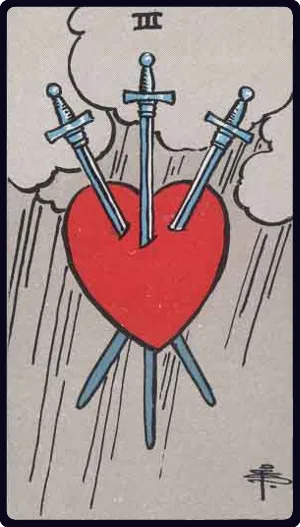
Rider–Waite–Smith
Three of Swords — Rider–Waite–Smith
Deck-native identity is shown first.
Deck-native identity
Upright, Three of Swords emphasizes honest acknowledgment. Distinguish the observable fact from its emotional impact, then identify the story being inferred before deciding what to say or do. If you use reversals, the only approved mode here is blocked: hurt or tension may be difficult to name or process, while analysis or defensive communication keeps the issue unresolved. A reversal does not promise healing or recovery.
Limit: This is a modern Venus synthesis based on the current canonical RWS-oriented reference page, not an ancient or universal doctrine. No individual visual cue is asserted in this brief; the local asset identity is known, while exact derivative provenance and rights remain unknown.
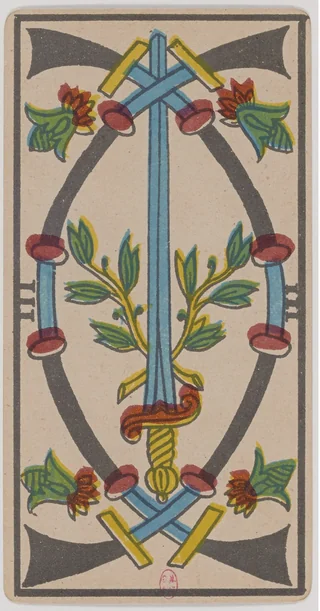
Lequart Besançon
Trois de Épées — Lequart Besançon
Deck-native identity is shown first.
Rank-and-suit correspondence
Trois de Épées can emphasize combining elements so a pattern can expand beyond its starting point, expressed through discernment, conflict, decisions, and consequences. When deficit, the same number-or-court structure can show insufficient integration, support, or shared purpose within discernment, conflict, decisions, and consequences.
Limit: This is a modern Venus number/rank-plus-suit synthesis, not a historical doctrine attributed to the Lequart maker. Read the pip or court structure directly; do not import an absent Rider–Waite–Smith narrative scene.
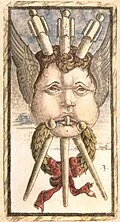
Sola Busca
Three of Swords — Sola Busca
Deck-native identity is shown first.
Rank-and-suit correspondence
The direct image can emphasize a truth or conflict that reaches the level of identity and cannot be managed as an abstraction. Pain can become defining, repeated, or weaponized when the person is reduced to the wound.
Limit: This is a modern Venus image-led synthesis, not a historical Sola Busca divinatory doctrine. Do not import an absent Rider–Waite–Smith scene; the observed local image and rank/suit structure control the reflection.
Card identities, numbering, image mappings, and semantic claims have been checked against the cited sources and reviewed evidence. Each meaning is a modern reflective interpretation—not historical doctrine, a prediction, or proof of an outcome.
How to read Three of Swords in a real spread
This is a reference meaning, not evidence that something happened. The question, orientation method, spread position, neighboring cards, consent, and known facts are all missing from a general card page.
Core layer
The card may foreground difficult feelings or tension that needs to be named, but it does not make heartbreak inevitable or identify its cause.
Reading angle
Write three separate lines: what you directly know, what you feel in response, and what you are currently assuming. The third line still needs confirmation.
Reality check
The card cannot select itself, supply a spread position, prove a future event or private state, or replace direct evidence, consent, communication, emergency action, or qualified health, veterinary, legal, financial, mental-health, or safety help.
Three of Swords upright meaning
Upright, Three of Swords emphasizes honest acknowledgment. Distinguish the observable fact from its emotional impact, then identify the story being inferred before deciding what to say or do.
Three of Swords reversed meaning
If you use reversals, the only approved mode here is blocked: hurt or tension may be difficult to name or process, while analysis or defensive communication keeps the issue unresolved. A reversal does not promise healing or recovery.
Three of Swords in love and feelings
In relationship questions, stay with observable tension, exact words, stated boundaries, and impact. The card cannot establish betrayal, infidelity, a third party, hidden motives, or another person's feelings.
Three of Swords in work and decisions
At work, separate a documented problem from the meaning attached to it. Review messages, decisions, responsibilities, and deadlines before naming a cause; the card cannot prove misconduct, betrayal, or an inevitable professional rupture.
Three of Swords in money and resources
For money or contract questions, use the card only to slow down interpretation. Verify statements, documents, amounts, and deadlines, and seek qualified advice rather than treating distress as proof of fraud, loss, or a fixed outcome.
Three of Swords as a Yes / No card
The default yes/no answer is unclear. It can lean yes only when the question is whether to name a verified tension carefully, and lean no when the proposed action depends on an unverified betrayal story.
Can lean yes when
A specific tension is verified and the next step is a careful, bounded acknowledgment.
Can lean no when
The decision assumes betrayal, hidden motives, or private feelings that have not been confirmed.
Tarot reader advice
Write down the observable fact, the feeling it evokes, and the assumption that still needs direct confirmation or qualified support. Then choose a careful conversation or support step only if it is appropriate and safe.
A painful reaction can be real even when its explanation is uncertain. The card's value lies in honoring the impact while refusing to turn suspicion into fact.
Known fact
Record only what was directly observed, said, written, or otherwise verified.
Felt impact
Name the emotional effect without diagnosing grief, illness, trauma, or anyone's private state.
Unverified story
Mark the conclusion that still requires conversation, evidence, or qualified support.
Source and limits
The local Rider-Waite-Smith-named image asset establishes no universal doctrine, provenance, authorship, edition, or licensing. This card cannot prove breakup, heartbreak, betrayal, illness, or a third party.
Use this card in a reading
Apply the Three of Swords to one verified tension
If you continue with a spread or one-card reading, keep the question narrow enough to distinguish what happened, how it affected you, and what still needs confirmation.
This public reference gives the complete learning meaning. An applied reading still needs a question, spread position, and context; it cannot supply hidden facts or a paid-only certainty about another person.