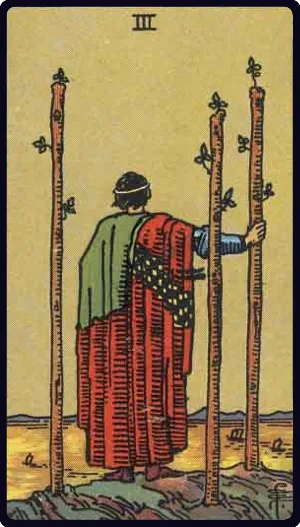
Three of Wands can bring an active plan into wider view. Its useful question is not whether expansion is guaranteed, but what has already moved, what feedback is returning, and whether there is enough capacity for the next reach.
Choose a deck to see the card identity, number, image, relation type, and modern interpretive emphasis supported for that system.
Rider–Waite–Smith
Three of Wands — Rider–Waite–Smith
Deck-native identity is shown first.
Deck-native identity
Upright, Three of Wands emphasizes outward perspective and deliberate follow-through. Review what is already underway, notice the response, and decide whether the next extension is supported rather than merely appealing. If you use reversals, the primary reading is blocked: perspective, feedback, or progress may be hard to access, leaving the plan waiting or poorly informed. A relevant alternative is excess, when expansion, visibility, or commitment is running ahead of capacity.
Limit: This is a modern Venus synthesis based on the current canonical RWS-oriented reference page, not an ancient or universal doctrine. No individual visual cue is asserted in this brief; the local asset identity is known, while exact derivative provenance and rights remain unknown.
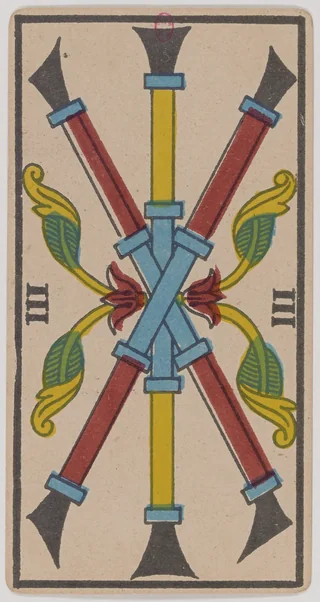
Lequart Besançon
Trois de Bâtons — Lequart Besançon
Deck-native identity is shown first.
Rank-and-suit correspondence
Trois de Bâtons can emphasize combining elements so a pattern can expand beyond its starting point, expressed through initiative, effort, enterprise, and direction. When deficit, the same number-or-court structure can show insufficient integration, support, or shared purpose within initiative, effort, enterprise, and direction.
Limit: This is a modern Venus number/rank-plus-suit synthesis, not a historical doctrine attributed to the Lequart maker. Read the pip or court structure directly; do not import an absent Rider–Waite–Smith narrative scene.
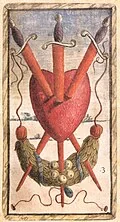
Sola Busca
Three of Batons — Sola Busca
Deck-native identity is shown first.
Rank-and-suit correspondence
The converging structure can emphasize several forces focused on one vulnerable purpose that needs careful alignment. Combined effort can pierce or overwhelm the central purpose when pressure replaces coordination.
Limit: This is a modern Venus image-led synthesis, not a historical Sola Busca divinatory doctrine. Do not import an absent Rider–Waite–Smith scene; the observed local image and rank/suit structure control the reflection.
Card identities, numbering, image mappings, and semantic claims have been checked against the cited sources and reviewed evidence. Each meaning is a modern reflective interpretation—not historical doctrine, a prediction, or proof of an outcome.
How to read Three of Wands in a real spread
This reference offers a theme, not an outcome. A personal reading still depends on the question, orientation method, spread position, neighboring cards, and the facts of the situation.
Core layer
A plan or effort may have moved beyond its first step and now need perspective, feedback, and a realistic check on what further reach would require.
Reading angle
Compare the response you hoped for with the response you can actually observe. Then ask whether time, attention, people, and resources support the next step.
Reality check
The card cannot select itself, supply a spread position, prove a future event or private state, or replace direct evidence, consent, communication, emergency action, or qualified health, veterinary, legal, financial, mental-health, or safety help.
Three of Wands upright meaning
Upright, Three of Wands emphasizes outward perspective and deliberate follow-through. Review what is already underway, notice the response, and decide whether the next extension is supported rather than merely appealing.
Three of Wands reversed meaning
If you use reversals, the primary reading is blocked: perspective, feedback, or progress may be hard to access, leaving the plan waiting or poorly informed. A relevant alternative is excess, when expansion, visibility, or commitment is running ahead of capacity.
Three of Wands in love and feelings
In relationship questions, look at visible initiative, distance, stated expectations, and follow-through. The card cannot prove attraction, a return, commitment, or another person's plans; those require direct communication, consent, and observable behavior.
Three of Wands in work and decisions
At work, use the card to review an effort already in motion: what has been delivered, what response came back, and what the next phase would demand. It does not promise business growth, recognition, travel, or a successful expansion.
Three of Wands in money and resources
For money or resource decisions, a wider plan still has to survive the numbers. Check budgets, documents, timing, and risk with appropriate professional advice; this card does not guarantee an incoming payoff or profitable growth.
Three of Wands as a Yes / No card
Three of Wands can lean yes only when a defined plan is already supported by capacity, timing, and observable feedback. Otherwise the answer is unclear, especially when it depends on future news or payoff.
Leans yes when
The plan exists, the next step is resourced, and real feedback supports extending it.
Stays unclear when
The needed response has not arrived, capacity is uncertain, or the hoped-for payoff is doing the work of evidence.
Tarot reader advice
List what has already been initiated, the feedback actually received, and the capacity required for one measured next step. That turns a distant possibility into a decision you can evaluate.
The card is most useful in the space between taking action and assuming a result. It asks for a wider view while keeping the reader anchored to what has actually happened.
What has moved?
Name the effort already underway and the concrete change since the first step.
What is missing?
Separate observable feedback from expectation, delay, or imagined news.
What can it hold?
Check whether the next extension fits the available time, resources, and commitments.
Source and limits
The Rider-Waite-Smith-named image asset identifies this page's local reference only. It does not establish universal doctrine, provenance, authorship, edition, licensing, or a predicted trip, message, growth, or payoff.
Use this card in a reading
Take the Three of Wands from horizon to question
If you want to apply this reference, start with one defined question about an effort already underway and choose a spread or daily reflection that keeps the missing context visible.
This public reference is complete for learning the card. An applied reading still needs a question, spread position, and context; no deeper report is required to check the plan against feedback and capacity.