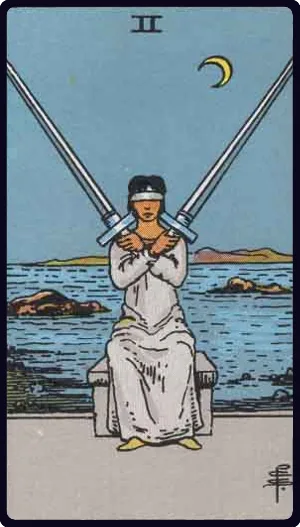
The Two of Swords can frame a held decision, guardedness, competing considerations, or limited information. Instead of assuming deception or refusal, use it to identify the fact or decision rule that could help the choice move.
Choose a deck to see the card identity, number, image, relation type, and modern interpretive emphasis supported for that system.
Rider–Waite–Smith
Two of Swords — Rider–Waite–Smith
Deck-native identity is shown first.
Deck-native identity
Upright, treat the card as a prompt to clarify the held choice. Name the competing considerations and the fact or criterion that would make movement responsible. If you use reversals, the primary reading is release: a held decision may begin to move as information or willingness changes. A secondary distortion may be pressure producing a reactive choice before the facts are clear.
Limit: This is a modern Venus synthesis based on the current canonical RWS-oriented reference page, not an ancient or universal doctrine. No individual visual cue is asserted in this brief; the local asset identity is known, while exact derivative provenance and rights remain unknown.
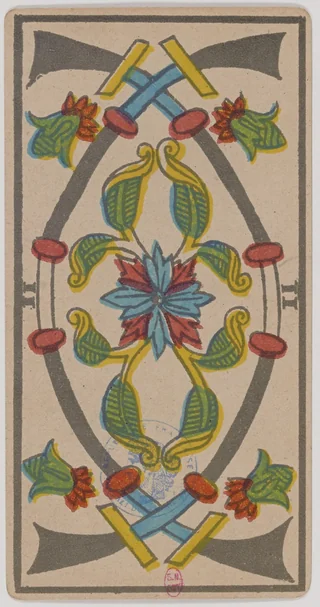
Lequart Besançon
Deux de Épées — Lequart Besançon
Deck-native identity is shown first.
Rank-and-suit correspondence
Deux de Épées can emphasize holding a polarity long enough to choose, compare, or coordinate, expressed through discernment, conflict, decisions, and consequences. When blocked, the same number-or-court structure can show opposition that becomes stalemate or split attention within discernment, conflict, decisions, and consequences.
Limit: This is a modern Venus number/rank-plus-suit synthesis, not a historical doctrine attributed to the Lequart maker. Read the pip or court structure directly; do not import an absent Rider–Waite–Smith narrative scene.
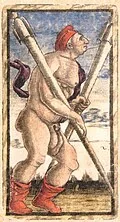
Sola Busca
Two of Swords — Sola Busca
Deck-native identity is shown first.
Rank-and-suit correspondence
The crossed load can emphasize acting while holding two incompatible considerations in view. Decision can stall or become self-conflict when neither consideration is given a clear criterion.
Limit: This is a modern Venus image-led synthesis, not a historical Sola Busca divinatory doctrine. Do not import an absent Rider–Waite–Smith scene; the observed local image and rank/suit structure control the reflection.
Card identities, numbering, image mappings, and semantic claims have been checked against the cited sources and reviewed evidence. Each meaning is a modern reflective interpretation—not historical doctrine, a prediction, or proof of an outcome.
A pause in decision is not proof of a hidden motive
This is a static reference, not evidence that anyone is withholding information. The spread position, question, neighboring cards, and known facts determine whether the Two describes caution, an unresolved criterion, or pressure to decide too soon.
Core layer
A held decision, guardedness, competing considerations, limited information, or a missing criterion may be in focus.
Reading angle
Separate what is known from what is missing, then ask which criterion would allow movement without forcing certainty.
Reality check
The Two of Swords does not prove stalemate, deception, blocked feelings, hidden information, pathological indecision, or another person's refusal.
Two of Swords upright meaning
Upright, treat the card as a prompt to clarify the held choice. Name the competing considerations and the fact or criterion that would make movement responsible.
Two of Swords reversed meaning
If you use reversals, the primary reading is release: a held decision may begin to move as information or willingness changes. A secondary distortion may be pressure producing a reactive choice before the facts are clear.
Two of Swords in love and feelings
In love, the card may prompt a clearer question or boundary. It cannot establish blocked feelings, withholding, dishonesty, conflict, or a decision by another person; ask directly and respect the response.
Two of Swords in work and decisions
At work, identify the unresolved criterion, approval, or document rather than labeling the situation a stalemate. Review the actual terms and set a responsible decision point.
Two of Swords in money and resources
For money, list the verified numbers and the information still missing. The card cannot prove deception or forecast a result, so use records and qualified advice for consequential choices.
Two of Swords as a Yes / No card
The answer is usually unclear until missing facts or decision criteria are addressed. The Two of Swords is not a permanent no.
The decision can move
The missing fact is available, the criterion is clear, and the choice is not being forced.
Uncertainty remains
A key fact is absent, or pressure is demanding certainty before the decision is ready.
Tarot reader advice
List the known facts, name the missing fact, and choose a decision deadline or criterion that does not force premature certainty.
Calling a choice blocked can hide the useful work. The Two of Swords becomes specific when you can name what is competing, what is missing, and what standard will guide movement.
Known
Which facts are already established?
Competing
What considerations pull in different directions?
Missing
Which fact would reduce uncertainty?
Criterion
What rule or deadline will guide the choice?
Put the decision in context
Use the Two of Swords to name what is missing
Choose a reading format for the reflective question, then use direct communication, records, and qualified advice to establish the facts.