The Two of Wands can frame planning, comparison, vision, and the moment before commitment. It does not promise travel or expansion; its practical value is helping you compare the familiar option with a wider possibility on evidence you can actually check.
Choose a deck to see the card identity, number, image, relation type, and modern interpretive emphasis supported for that system.
Rider–Waite–Smith
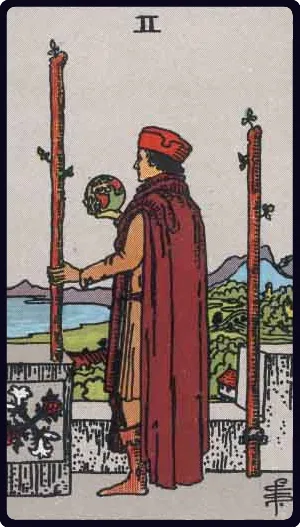
Two of Wands — Rider–Waite–Smith
Deck-native identity is shown first.
Deck-native identity
Upright, compare the real options before choosing a direction. Name what each path requires, the constraint each carries, and the fact that would make commitment responsible. If you use reversals, the primary reading is blocked planning or agency held by untested assumptions or insufficient grounding. A secondary excess may be rushing expansion before capacity is known.
Limit: This is a modern Venus synthesis based on the current canonical RWS-oriented reference page, not an ancient or universal doctrine. No individual visual cue is asserted in this brief; the local asset identity is known, while exact derivative provenance and rights remain unknown.
Lequart Besançon
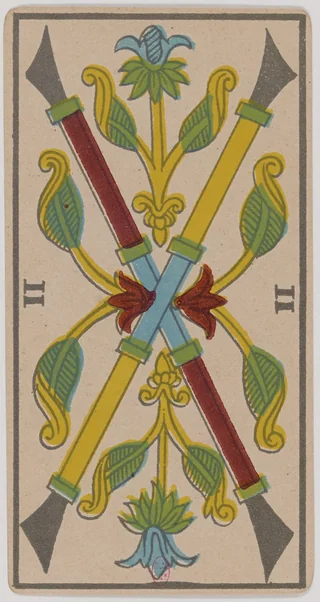
Deux de Bâtons — Lequart Besançon
Deck-native identity is shown first.
Rank-and-suit correspondence
Deux de Bâtons can emphasize holding a polarity long enough to choose, compare, or coordinate, expressed through initiative, effort, enterprise, and direction. When blocked, the same number-or-court structure can show opposition that becomes stalemate or split attention within initiative, effort, enterprise, and direction.
Limit: This is a modern Venus number/rank-plus-suit synthesis, not a historical doctrine attributed to the Lequart maker. Read the pip or court structure directly; do not import an absent Rider–Waite–Smith narrative scene.
Sola Busca
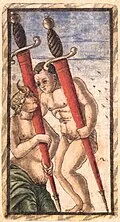
Two of Batons — Sola Busca
Deck-native identity is shown first.
Rank-and-suit correspondence
The pair can emphasize coordination, negotiation, and the need to align separate efforts before force is applied. Coordination can turn into rivalry, coercion, or duplicated effort without a shared aim.
Limit: This is a modern Venus image-led synthesis, not a historical Sola Busca divinatory doctrine. Do not import an absent Rider–Waite–Smith scene; the observed local image and rank/suit structure control the reflection.
Card identities, numbering, image mappings, and semantic claims have been checked against the cited sources and reviewed evidence. Each meaning is a modern reflective interpretation—not historical doctrine, a prediction, or proof of an outcome.
Compare before you commit
This page is a static reference, not a selected card or a forecast of your next move. The question, position, neighboring cards, and real options determine whether the Two describes planning, an obstacle to agency, or advice to widen the comparison.
Core layer
Planning, comparison, vision, agency, and movement beyond what is familiar may be in focus.
Reading angle
Put the known option beside the wider possibility and identify the evidence needed for a responsible choice.
Reality check
The Two of Wands does not guarantee travel, expansion, relocation, partnership, business success, or a specific future choice.
Two of Wands upright meaning
Upright, compare the real options before choosing a direction. Name what each path requires, the constraint each carries, and the fact that would make commitment responsible.
Two of Wands reversed meaning
If you use reversals, the primary reading is blocked planning or agency held by untested assumptions or insufficient grounding. A secondary excess may be rushing expansion before capacity is known.
Two of Wands in love and feelings
In love, the card may frame comparison, initiative, or planning. It cannot prove attraction, partnership, or another person's plan, so use behavior, explicit consent, and direct conversation.
Two of Wands in work and decisions
For work, separate a broad vision from a viable plan. Verify the offer, role, resources, timeline, and consequences before reading the card as expansion or business success.
Two of Wands in money and resources
A larger horizon can still carry costs and constraints. Compare the numbers, terms, and risk of both options; use qualified financial or legal guidance when needed.
Two of Wands as a Yes / No card
The answer is usually unclear until options, capacity, and facts are compared. It may lean yes only after a viable direction is chosen; there is no permanent polarity.
A direction is viable
The options were compared on a real criterion, and the preferred path fits current capacity.
The map is still imagined
The decision depends on assumptions, missing terms, or expansion that has not been costed.
Tarot reader advice
Write down the two real options, one constraint for each, and the fact that would make the next step responsible.
The Two of Wands is not valuable because it makes the horizon bigger. It is valuable when a wider possibility can be compared with the known path without surrendering agency to prediction.
Known path
What does the familiar option actually offer?
Wider path
What possibility deserves a fair comparison?
Constraint
What limits each direction?
Criterion
Which fact would make a choice responsible?
Move from vision to comparison
Use the Two of Wands with two real options
Choose a spread only after you can name the directions being compared and the evidence that would make one viable.